It’s Really Real.

books

A 14 hour shift, from 3:30 AM to 5:30 PM, on two hours of sleep.  Not an ideal situation by any means, and made far worse by the reason for it: Black Friday.  To say I was exhausted when I got home would the greatest of understatements.  Closer would be that I felt like I’d been beaten with sticks and dragged backwards by one ankle through a running bumper car carnival ride.  Couple that with the strange, overwound feeling you get when you drink 6 cups of coffee and not eat enough and you’ll have a pretty good idea of how I felt on Friday when I got home.

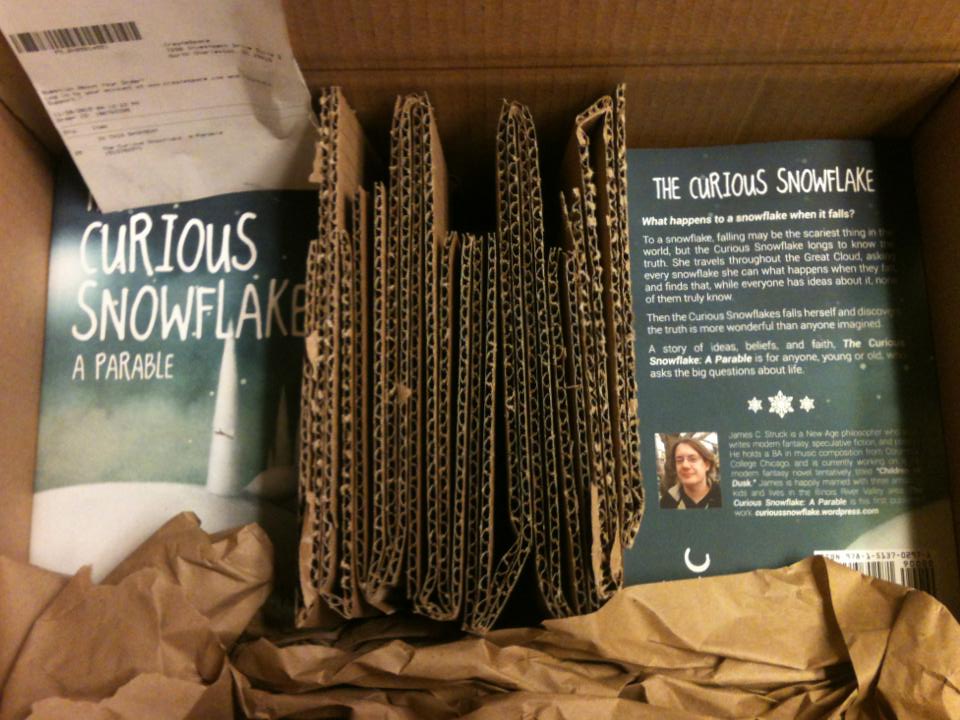
And then I got this box.

I got the original idea for The Curious Snowflake sometime around the autumn of 2005, give or take.  I finally put it down on paper in April of 2009, published it on Kindle in September of 2010, and finally got behind self-promotion of it in late summer of 2013.  I first heard of my publisher Booktrope last autumn from my dear friend and fellow author Dennis Sharpe, sent my query email to them in February, got accepted in April, and spent the entire summer in team building, edits, and adjustments. Ten-and-a-half years this idea has been with me.  In that time my two youngest children were born, we moved 100 miles from where my wife and I grew up, I went from a part-time librarian to a full-time retail manager, I cut off my ponytail, gained 15 pounds, lost 30, then gained 15 back again, bought a house, went gray and got bifocals.  Yet this idea has remained, and my belief in it has never wavered.  My philosophy has evolved, deepened, matured, and the edits show that, but the core of TCS is unchanged: curiosity is beautiful, no one really understands life completely, the insistence on being Right is the most damaging idea humans have ever devised, there is no judgment in the Divine, All is One merely appearing separate.  The durability of TCS’s basic ideas is my greatest philosophical joy, and my greatest source of gratitude.

And here it is, at long last. I can hold it in my hands.

I opened the box in the kitchen, surrounded by over-bright florescents and that horrible 70’s yellow wallpaper we haven’t gotten rid of just yet, and just smiled.  Then I called my wife in and handed her the first copy out of the box.  She grinned and threw her arms around my neck, whispering in my ear how proud she was of me.  I handed a copy to each of my kids, then took the other 21 into the bedroom, carefully unpacked them, and spread them out on the bed.  Then I just sat there and stared at them, too exhausted to do the silly happy dance I otherwise would do, trying to wrap my head around the truth: I am a published author.

I don’t know what will happen now.  TCS could continue to flounder in obscurity, despite everything Booktrope and my book manager and I will do.  It could sell a few hundred copies, touch a few people, and then be forgotten.  It could take off, allow me to be a full-time author, share my ideas for a living.  I have no idea.  None of that really matters right now, though.  What matters is those words, on a page in a real book, those words I wrote over a decade or so, on a yellow legal pad, while sitting on my bed.

“Once upon a time there was a Snowflake.”

🙂

Virtues and Vices, Part 2: Goodness and Pride

The second pair of virtues and vices I wish to talk about are the ones associated with monotheism, goodness versus pride. When rewriting TCS I found this part to be the most difficult for me to edit, mostly because I was skirting very close to some rather controversial points of view, especially for a kid’s book.  But one cannot discuss the ideas of good and bad, let alone prideful morality, without touching on some ideas that people don’t really want to look at too closely.  So let’s move forward.

People don’t like and don’t want hard religions.  When I say “hard” I don’t mean challenging.  Challenging is fine because it lends a sense of moral superiority to one’s efforts, which many people like.  What I mean by hard is religions that push people out of their comfort zones.  When it comes to spirituality, we like our absolutes.  We like formulas and rituals.  We want to know that, if we do A, B, C, and D and avoid W, X, Y, and Z, we will win the kewpie doll.  We also want an endgame, so to speak, a final goal where, if we put in the required effort, we will be rewarded and not have to put the effort in anymore.

Why do we want our religions to be this way?  Simple: because life ISN’T this way.  Life is ambiguous, not absolute.  Life always challenges us, it never lets us rest for any significant amount of time.  Formulas do not work for life, because inevitably something comes along and knocks the formula out of whack. Because of this, every religion considers the world to be an impure, flawed, or corrupted place and describes its final reward as a place of peace, simplicity, and effortlessness.  Nowhere is this more true than in Western Monotheism (WM).  The rules and rituals are absolute, laid out by the Divine Itself.  The world is a horrible place that, at the End of Days, will be destroyed and made new.  The non-believers should be converted or ignored at best, at worst… well, you know, I’m sure.

Yet WM abounds with ambiguity, though it turns a blind eye to such inconsistencies.  Every moral precept of the 10 Commandments is broken in the Bible itself at one point or another.  Entire sections of moral code are ignored or explained away as “old Covenant” teachings.  Internal contradictions abound.  Yet believers everywhere ignore this, set their feet and square their shoulders, and say they have found the One True Path.  This is Pride.  Pride is when Goodness becomes a show, a form of posturing, when thought and experience are set aside in favor of surety and the support of a community who agrees with you.  Pride is what allows the leader of a religion founded by a wandering socialist carpenter to sit on a golden throne in a palace.

But what if Life is right?

Now, bear with me as we jump down this rabbit hole.  I am not saying right and wrong do not exist, they do and demonstrably so.  What I am saying it that right and wrong are human constructions that only exist based upon human preference, proclivity, instinct, and certain overarching aspects of existence.  Good is not created by God, but by us.  And that is perfectly and gloriously okay!  Killing is wrong, not because God carved that rule into a rock, but because we value our own existences and understand that others are just like us.  We would not wish to be killed, and others must feel the same, therefore killing another person is wrong under the majority of circumstances.  Adultery is wrong, not because the Bible says so, but because betrayal of trust hurts us emotionally and damages the fabric of our society.  Rape is wrong because it takes an act of love, trust and expression of Unity and turns it into an act of violation, selfishness, and domination.  Dishonesty is wrong because it damages the value of trust, which is necessary for social interaction to have any meaning.

Deep stuff to try to fit into a kid’s book, huh?

As I said, this is a touchy subject, and I’m pretty aware that it may cause me some conflict down the road, but I honestly feel that the idea of divine-dictated moral absolutes is one of the most damaging concepts in the history of humanity.  How many wars, how much conflict, how many atrocities have been committed because someone was able to justify away their actions based on a moral absolute?  Do you need a list? My goal in writing and publishing TCS is to plant a few tiny seeds of peace and joy and love in the hearts of young people and new families.  This is, for me, the most important of those seeds.

Virtues and Vices Part 1: Beauty and Vanity

Hello, and welcome to my #mondayblogs post.  I was inspired by my friend Galit Breen to post today about physical appearances and beauty, the difference between the two, and how that ties into my soon-to-be-published book.  Enjoy

Something new I added during my rewrite of The Curious Snowflake was an emphasis on what I call Virtues and Vices.  In TCS, the main character travels to all different parts of the Great Cloud in search of answers about life, and each shape of snowflake represents a different philosophy here on Earth.  The star-shaped flakes represent atheism, the needle-shaped flakes polytheism, and the pebble-shaped flakes monotheism.

Each life-philosophy has a particular virtue it prizes over all others.  Atheism, since it has no concept of an afterlife, prizes personal accomplishment, which in TCS I simplify into Beauty.  Monotheism, with its belief in single lifetimes, emphasizes living in accordance to divine laws, which I simplify into Goodness.  Polytheism, with its belief in reincarnation and Karma, emphasizes personal striving towards an ideal of spiritual perfection, which I simplify into Courage.  Each of these Virtues also has a corrupted form which comes into play when an individual places too much emphasis on the appearance of virtue rather than virtue itself.  Courage changes to Recklessness, Goodness into Pride, and Beauty into Vanity.  For this first part, I would like to talk about the last of these three.

We live in a society that places incredible emphasis on external appearances, especially for women, but teaches us almost nothing about the true nature of beauty.  Dress size, perfect hair, flawless makeup, chiseled jawline, washboard abs, pouty lips, these are not beauty and have nothing to do with beauty.  These are attractiveness.  These are nothing more than biological posturing, remnants of our animalistic past where finding a mate was all about passing on good genes and nothing more.  Physical attractiveness is simply a billboard for your DNA.  Strong, even teeth, glossy thick hair, flat stomachs, good musculature, these are indicative of a healthy lifestyle, which promotes you as a good hunter or smart gatherer.  Wide hips and full breasts in women; muscular arms and broad chest and shoulders in men; long legs, upright posture, and clear eyes in both sexes; these are indicators of good genetic material and nothing more.  They are not beauty, they are vanity, pure and simple.

Beauty is something completely different.

Beauty is an indicator of who you are, not how you appear.  A Beautiful person is someone who is on the path to who they truly wish to be and advertises it to the world with neither shame nor hesitation.  Think of a time in your life when you were around someone who was truly on a path forward to their dreams.  What was that person like?  Didn’t they seem to glow, to have an almost magnetic field around them?  Didn’t you feel yourself drawn to them, regardless of their appearance or their gender?  That is Beauty.

Think now about the great souls who have populated this world over the last century or so.  Think of a Mahatma Gandhi, a Mother Teresa, a Dalai Lama.  Were these physically attractive people?  Lord, no, but they were and are Beautiful people.  Think of someone who truly inspired you at some point in your life.  For me it was an old college voice coach who was about as wide as he was tall, but I think back about Jim Parks and he is one of the most Beautiful people in my personal experience.

As I said in my previous blog post here, my goal with TCS is to show a new way of thinking about the world, one sharable with all ages and all generations.  This shift towards a healthier perspective on Beauty is one part of that.

The Purpose of a Snowflake

What is the purpose of a snowflake?  While this is a question I circle back to many times in TCS, I would like to answer it a bit more literally and personally.  What was my purpose in writing TCS in the first place? What was I trying to accomplish?

Before I wrote TCS, before I wrote any of my philosophical works (most of which have yet to see the light of day) I spent a good 15 years developing my personal philosophy.  I devoured just about any book on religion and spirituality I could get my hands on, from ancient classics like the Bible, the Bhagavat Gita, and the Tao Te Ching to modern writers like Neale Donald Walsch, James Redfield, and Richard Bach.  In doing this, I noticed a pattern.  Most ancient spiritual writings are simple.  They rely on repetition, patterns, stories, and allegories to get their points across.  They tend to use simpler language, yet they are not shallow.  On the contrary, they usually have multiple layers of meaning and leave themselves open to a certain degree of interpretation.  They can be understood on the simplest level by children, yet can be delved deeper into by older believers.

On the other hand, most modern spiritual writings tend to be thick, heavy-handed things that assume a certain degree of maturity on the part of the reader.  I would never dump Ram Dass or Eckhart Tolle into the lap of anyone under the age of 18 or so, for example.  Yet by the time someone is an adult or near enough, they already have some degree of a philosophical framework, usually one they inherited from their parents, so there is an unlearning that they need to go into in order to appreciate these new ideas.  Very little New Age writing is geared towards a younger reader or a beginner.  There are a few exceptions, The Little Soul and the Sun by Mr. Walsch comes immediately to mind, but they are far from the rule.

That, obviously, is where I want TCS to come in.

I intend TCS to be a primer, an introduction to what I call Unity Theory.  It covers the basic tenets of my philosophy: the Oneness of all things, the lack of a judgmental Deity or afterlife, the rough outlines of reincarnation, the purpose of life being experience, the (admittedly controversial) idea that good and bad are human concepts and not external absolutes.  But I try to do this in such a way that even children can understand them.

The world, as it stands now, is not a true reflection of what we as humans desire.  Our concepts of self, of right and wrong, and our priorities are out of phase with our actions.  We, as a species, are behaving in ways that are self-destructive and run counter to what we as a species actually want: love in our lives, health in our bodies, connection with others, and a sense of purpose.  The only way I feel this can change is if we change our core thinking about our relationship to each other and to all of existence, and this can only happen if we start teaching different core values from the earliest age.  Do I think TCS fits this bill?  Of course not, I am not that arrogant.  But I believe it is one small step in the right direction.