Politics, Religion, and Spirituality
Let’s talk politics.
Yeah, yeah, I know, that’s a forbidden subject. Keeping a blog is a little like going to Thanksgiving dinner; there are certain subjects you don’t want to broach because you know it will get messy. But I’m not here to talk about my personal politics (though I will use them as a jumping-off point) so much as I want to talk about how politics and spirituality intertwine, whether we want them to or not.
So let’s start with the obvious. I am a college-educated, non-affluent, Gen-X white male who writes alternative spirituality books, so my political leanings should be pretty predictable: liberal as they come. Part of the reason I am such a complete and utter hippie is because of my distaste for the encroachment of traditional religious views into modern public and political discourse. For someone whose spiritual views put the ideas of Werner Heisenberg, Lao Tsu, and Origen of Alexandria on the same footing, the idea of young-Earth creationism appearing in school textbooks is horrifying to say the least. So of course I trot out the same arguments so many others of my ilk do: the First Amendment, the Deist leanings of many of the Founding Fathers, the mountains of evidence for evolution and an ancient Earth, so on and so forth. We of a liberal mindset believe that we are bastions of reason against a sea of antiquated myths and fables, doing our best to hold our secular government sacrosanct from the influences of religion and its biases.
But are we really?
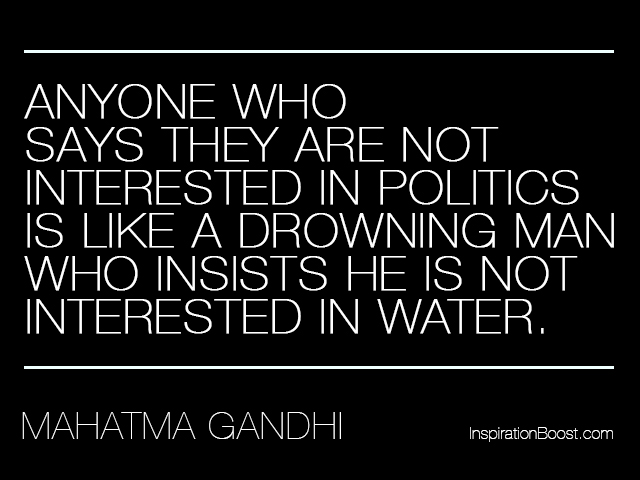
Look at the quote at the beginning of this post. Mohandas Gandhi is remembered in the West as a political leader, one who used nonviolence as a brilliant weapon of propaganda to push Britain out of India. Yet in his home country he is revered as much for his spiritual teachings as his political influence, earning the title Mahatma, meaning “great soul”. For him, as you can see above, spirituality and politics were inextricably intertwined, and for good reason. Both are structures by which we govern and decide what is acceptable or unacceptable in a society. One uses social pressure and upbringing to enforce behavior, the other uses law and punishment, yet the both work toward the same end.
Americans sometimes forget that we and our time period are an anomaly. For the majority of human history, political and religious power were interconnected and often indistinguishable. For centuries kings ruled by divine right, popes held more influence than rulers, and a threat of excommunication was worse than death. Our ideas of the separation of church and state are unique in history, and also almost impossible to enforce 100%. How many laws have made it to the books in the United States whose basis is nothing more than assumptions based on Judeo-Christian teachings? Every malediction against family planning, every heavy penalty for substance abuse, every attempt to criminalize non-traditional relationships is really nothing more than the Bible creeping into our lawbooks.
Yet this is not all bad. Many of the finest dignities of humanity enshrined in our laws have their basis in religious doctrine. Prior to Judaism, human sacrifice for religious purpose was the norm, property was only held through strength, and women were purely chattel to be stolen, bartered, and enslaved. Religion changed all that, and I think we can all agree that it was for the better. To deny religion’s hand in the creation of our current ideas of morality is disingenuous at best and blind at worst.
That really is the main division between American liberalism and conservatism; can law and morals be separated from traditional religion, and should it? The former says yes, we can find the dignities in our traditions and keep them while discarding those which no longer reflect the society we desire. The latter says no, we cannot separate our laws from their source without undercutting them completely. Problems then arise, because the stalwarts of either side end up taking things to their extremes. Liberal extremists deny religion any hand in our laws or morals despite their obvious source, conservative extremists insist that all religious tenets must be included in laws, no matter how archaic or inappropriate. This is exacerbated in American politics by a myriad of other influences: gerrymandering, campaign financing, religious tax exemption, and others.
So where does that leave someone like me? How do I ditch the bathwater while keeping the baby? What part of morality can be separated from religion, if any? For me personally, I feel the need to take things back to the source. Is there a basis for morality, and therefore law, that runs even deeper than what traditional religions teach? Is there a kernel, a perennial philosophy that underpins religion and therefore can be used as a basis for law without interference from cultural accumulations? This is what I search for and what I try to express in my writings.
I think I’m onto something, but whether you agree with me is up to you.


 James C. Struck: Author of The Curious Snowflake