A Critique of the Modern Dystopia Fad

dystopia

love a good dystopia.

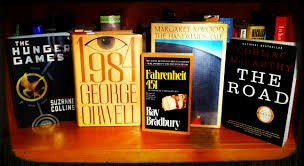
I don’t know why, really. I am a very optimistic person (a little too optimistic if you ask my wife) and I truly believe that, while we as a species have made some rather dopey choices over the last 150 years or so, we can still right the ship and create a better world than the one we currently occupy. But this doesn’t change the fact that my book collection holds a plethora of well-worn dystopian novels. I have read the classics numerous times: 1984, Brave New World, Fahrenheit 451, The Handmaid’s Tale, and so on, and I find them fascinating. I think it is connected with my love of understanding people and what makes them tick; what is the difference, really, between a foul-tempered, controlling person and the nation of Oceania?  The latter is simply the former writ large.

In case you’ve been living under a literary rock (and if you’re reading this blog I highly doubt that) dystopias are a hot commodity right now, and I’ve loved them.  Hunger Games?  Excellent, though I actually like Ms. Collins’ Gregor the Overlander series a little better.  Insurgent?  Also good, though I’ve only read the first book.  Ready Player One?  Just knocked it out in about 36 hours, talked it up to everyone.

But they’re not really dystopian.

Now, they are dystopian settings, to be sure.  President Snow’s cruelty would make Big Brother nod in approval, and Huxley’s Soma has nothing on the OASIS, but in these modern dystopias, the characters are placed front and center, not the world.  They have moments of triumph, moments of peace, moments of love, and these drive the narrative.  More importantly, there is a ray of hope in the modern dystopias. It may be a dim ray, but it is there. In the great dystopian classics, the hope only exists to us, not to the characters. We know that Offred’s world changes, we know that books still exist in Montag’s mind even after being burnt, but these salvations are not meant for the characters we’ve come to know.

This dissonance between the hopelessness of the world and the hopefulness of the characters grates on me slightly. In my heart, I don’t want the characters to win.  I don’t want happily ever after, or any after, really.  What I want from a dystopian novel is a note of caution.  I want them to be a warning to us, that these imaginings are far more proximate to our reality than we want to realize.  Just a nudge, a bump of the hip, and we could be there, slogging in the coal mines of District 12 and praying not to become tributes, or jacked into our haptic rig for 18 hours a day, every hair shaved for maximum contact.  Dystopian novels are supposed to be cautionary tales, and these modern stories, for all their undeniable quality, lack that.

A Sense of Accomplishment

I start way more things than I finish.

I think that’s pretty common for writers.  We get the idea, the great and glowing thing in our heads, and we dash off to our computer (or in my case, my notebook) and get to work, scribbling or tapping away.  Sometimes the idea just dries up and we stop.  Sometimes we keep going for a while and then we get another idea and drop the first one.  Sometimes we keep at it but our doubts and insecurities and lives and busyness and procrastination and what have you just get in the way.

But sometimes, just sometimes, none of this happens.

I’ve just today finished the longest thing I’ve ever written.  It took me 13 months (yeah, no NaNoWriMo for Jimmy) to write 157 pages of longhand YA modern fantasy novel.  It’s the first time I’ve ever finished anything close to this length that was fiction; most of my longer stuff is philosophical ramblings.  The previous story record was about 50 pages and that was in 2003.  And the best part is that I’m not done.  The story, assuming I finish it, is a trilogy.

So why am I bothering to document this in Cyberspace, and why do I think anyone else will give a crap about it?

We live in a society where accomplishment is measured in material things.  Success is weighed in square footage of house, names on clothing tags, shininess of car.  We rarely allow ourselves, or perhaps we are rarely allowed, to feel accomplishment for its own sake, to just feel good about “hey, I did that”.  It has to be “okay, you did that, now what will you do with it?”  Everything has to be a product.

Yet real accomplishment has nothing to do with that.  Our sense of worth and worthiness is garnered from being something, not having something.  Think of the times you really felt good about yourself.  Did it have anything to do with some material acquisition, or did it come from within?  Neale Donald Walsch once wrote that part of the reason our society is so unhappy is because we have what he calls the “be/do/have paradigm” upside down.  We think that, in order to be something, happy for instance, we have to have something first, like more money.  This having will allow us to do things (take a trip, buy a house, pay a bill) which will then allow us to be what we want (happy).  He says that we have this backwards.  We instead should decide what we want to be, then do things that move us towards that.  This will then create things to have that work with the doing and being.

Today I have finished my book.  I did this because I chose to be a writer and to stick to it, no matter what.  This led me to do something, which was to make time to write every day, even if it was just a few minutes to write a few words.  This made it possible for me to have a finished book, and a great sense of accomplishment because of it.

Mr. Walsch might be onto something. 🙂

What It’s Like To Be A Writer

20150707-202009.jpg

Being a writer is unlike any other creative profession, and I know this because I’ve tried quite a few. I’ve been a performing musician since I was a kid, and trust me, writing is completely different than music or theatre or just about anything else I’ve ever tried. Why? Because writers are completely nuts. Let me give you a few examples.

We have people living in our heads, and they can be little assholes.

Writing can be a very inconvenient creative outlet, mostly because the characters that we dream up (or perhaps find, but that’s a different blog post) really are little people in our heads. And just like real people, fictional people can be demanding. They want attention, have cranky days, act impulsively and thoughtlessly, and sometimes want to be heard at times that are inconvenient to say the least. Like while you’re driving 70 mph down the interstate. Or at 2:30 AM.

Worse yet, they have times when they don’t want to talk to us. Maybe they’re sulking, maybe they’re tired, maybe they’re just feeling stubborn, but no matter the reason sometimes our fictional friends just clam up. Of course, we writers aren’t really allowed to deal with this the way we really should. If a friend or a loved one decides they don’t want to talk to you, it’s perfectly acceptable to get upset or hurt, but if a fictional character does? Suck it up. Doesn’t matter how much you miss them, doesn’t matter how much it hurts, because as far as the rest of the world is concerned, fictional people aren’t real.

We writers know better. Yes, I know how crazy that sounds.

We have strange obsessions with things having to do with writing and the written word.

I am an old school writer, pen and paper. Mostly this is because it keeps me from editing the idea to death, but the downside of this I am obsessed with notebooks and pens. In any room of my house there are at least 3-4 notebooks hidden somewhere: shoved onto bookshelves, mixed in with my sheet music, on the end table, under the couch, on the dresser. And yes, this does not endear me to my loving wife.

Of course, she also bought me a leather bound journal for Father’s Day. Thank you, my Love. 🙂

Then there’s my pens. Unlike notebooks, where I am a gourmand, with pens I am a gourmet. I buy and use one kind of pen and one kind only: Pentel RSVP Black Fine Tip. I believe I have at least 42 of them scattered around my house and my work, as well as at least one package of multicolored RSVPs for edits.

And yet every time I go to Target or Walmart or (oh god help me) Staples, I am drawn to the stationary aisle as though there’s a black hole there that only affects me. They’re a drug, I’m addicted.

And don’t get me started on our book collections

One day, the foundation of my house is going to throw up its figurative arms, say “gg”, and collapse under the sheer weight of the books inside it. This is SO much worse than the notebook thing, partly because I’ve been reading since I was 4 but writing only since I was 15, but mostly because my whole family are addicts of the written word. There isn’t a horizontal surface in my house that does not house at least one book. The closing of a local book store was a cause for tears, no joke. No book aisle can be simply walked past by my family.

Every author I know is like this. Our bookshelves are packed two rows deep and then more books are stacked in front of them, usually divided into “read”, “unread”, and “get to it one day”. And god help us if we discover a new author we love, especially a prolific one. Or a series that is out of print, that’s even worse.

Discount bins? $1 racks at local resale shops? Library book sales? They’re like rolling a wheelbarrow of crack out in front of a junkie. I could not tell you how many books I’ve purchased because “it’s only $1, it’s only $.50”. Shit I will never read. I bought a copy on the Quran in Arabic and a Latin Vulgate Bible. Why? They were pretty and I wanted to see if they would spontaneously combust if I put them next to each other on the shelf. It’s pathetic.

Mood = Creative Output

There is nothing, nothing more sad and pathetic than a stuck writer. I know, I’ve been there. It’s like being emotionally constipated. We are surly, moody, sulky, and generally unpleasant to be around.

If anything, being on a roll is worse.

Not for the writer, mind you. For us, being on a roll is like being in love: Cloud Nine. But just like being in love, the only person who can stand being around us is the object of our affection. To everyone else, we are vague, selfish, absorbed, and obsessed. I knocked out my first draft of The Curious Snowflake in less than two weeks, and my wife told me later I was impossible to live with, utterly somewhere else. The only time writers are worth being around are on good editing days, and even that’s a stretch.

Everybody else is character fodder.

My MMC in my WIP (male main character in my work-in-progress, get with the nomenclature) is part me, part my son, and is based physically on one of my employees. His mentor is a short version of an old college buddy. The villain is my old voice coach (actually a great guy).

This is how it works. Authors want to make characters who are actually people, so they end up being a pastiche of the people we actually know. Famous, best selling authors do this all the time. Don’t believe me? Read the section at the beginning of Stephen King’s On Writing where he talks about meeting his wife and then go back and read, say, ‘Salem’s Lot or The Stand. Yeah, there’s a little Tabby King in almost every FMC ol’ Steve’s ever written.

So don’t piss off your writer friends, or you might find yourself immortalized in their prose.

So yeah, we’re basically nucking futz

Obsessive. Selfish. Oblivious. Moody. Judgmental. Perhaps even a little schizo-affective. So why does the rest of the world put up with us writers? Because we are also are loving, inspiring, thoughtful, and (at the best times) a little bit amazing. Most important, we write these stories and ideas that touch other people in positive and even wonderful ways. For that, I think, the rest of the “normal” people should cut us nutty authors a little slack.
Read To Your Kids

“It’s my turn to go first!”
“No, you went first yesterday!”
“But Daddy was at work so we didn’t read mine.”
“I want to sit in the middle!”

This is our chaotic and wonderful nightly ritual: story time. My kids are 16, 9 1/2 and 8, and this has been a part of out evenings for years. We eat dinner, shower when applicable, jammie up, and squeeze together onto our couch to read; my wife, me, and the younger two E and G shoehorned together, and our galumphing teenager D on the love seat because he just doesn’t fit anymore.

Over time the ritual has changed. Originally it was a chapter for the oldest and a picture book apiece for the others, and for a bit D dropped out due to lack of interest in Dick and Jane and Dr Seuss, but about 3 years ago it turned into a whole family tradition.

My wife and I are both voracious readers and were both precocious kids, so it was no surprise that all three of our children read early and easily. By the time E and G were school age they were losing interest in the “age appropriate” literature and wanted something they could sink their teeth into. So, trusting in my kid’s maturity and wanting to challenge them a bit, I dug into our own collection and pulled out Harry Potter.

Good call, Jimbo, good call.

Needless to say, they loved it. Even D, who had decided that gaming online with school friends was more fun than story time, gravitated over to listen. Over the course of 8 months we plowed through all 7 HP novels, then moved onto others: The Hobbit, Series of Unfortunate Events, the ‘Nother Story trilogy, Where The Mountain Meets the Moon, and most recently Narnia and Percy Jackson. Always, I am amazed at how much the younger two retain, even when they get antsy and don’t seem to pay attention, and always I am amused at how much D enjoys himself, even when he feigns disinterest.

Now I’m not claiming that nightly stories are the secret to the perfect family. Our kids are not perfect and neither are we. There are fights and boredom and sass and moments of lost temper from all 5 of us. But I’m pretty sure we are raising a family with an appreciation for the written word. I’m pretty sure that we are creating good bonds with our kids. And most importantly, my wife and I are pretty sure that, despite the imperfections, we are creating good memories. When D and E and G are grown, my hope is that they will look back at their childhoods, remember this, and smile. That, I think, is the best thing a parent can give their children.

So read to your kids.

Virtues and Vices, Part 2: Goodness and Pride

The second pair of virtues and vices I wish to talk about are the ones associated with monotheism, goodness versus pride. When rewriting TCS I found this part to be the most difficult for me to edit, mostly because I was skirting very close to some rather controversial points of view, especially for a kid’s book.  But one cannot discuss the ideas of good and bad, let alone prideful morality, without touching on some ideas that people don’t really want to look at too closely.  So let’s move forward.

People don’t like and don’t want hard religions.  When I say “hard” I don’t mean challenging.  Challenging is fine because it lends a sense of moral superiority to one’s efforts, which many people like.  What I mean by hard is religions that push people out of their comfort zones.  When it comes to spirituality, we like our absolutes.  We like formulas and rituals.  We want to know that, if we do A, B, C, and D and avoid W, X, Y, and Z, we will win the kewpie doll.  We also want an endgame, so to speak, a final goal where, if we put in the required effort, we will be rewarded and not have to put the effort in anymore.

Why do we want our religions to be this way?  Simple: because life ISN’T this way.  Life is ambiguous, not absolute.  Life always challenges us, it never lets us rest for any significant amount of time.  Formulas do not work for life, because inevitably something comes along and knocks the formula out of whack. Because of this, every religion considers the world to be an impure, flawed, or corrupted place and describes its final reward as a place of peace, simplicity, and effortlessness.  Nowhere is this more true than in Western Monotheism (WM).  The rules and rituals are absolute, laid out by the Divine Itself.  The world is a horrible place that, at the End of Days, will be destroyed and made new.  The non-believers should be converted or ignored at best, at worst… well, you know, I’m sure.

Yet WM abounds with ambiguity, though it turns a blind eye to such inconsistencies.  Every moral precept of the 10 Commandments is broken in the Bible itself at one point or another.  Entire sections of moral code are ignored or explained away as “old Covenant” teachings.  Internal contradictions abound.  Yet believers everywhere ignore this, set their feet and square their shoulders, and say they have found the One True Path.  This is Pride.  Pride is when Goodness becomes a show, a form of posturing, when thought and experience are set aside in favor of surety and the support of a community who agrees with you.  Pride is what allows the leader of a religion founded by a wandering socialist carpenter to sit on a golden throne in a palace.

But what if Life is right?

Now, bear with me as we jump down this rabbit hole.  I am not saying right and wrong do not exist, they do and demonstrably so.  What I am saying it that right and wrong are human constructions that only exist based upon human preference, proclivity, instinct, and certain overarching aspects of existence.  Good is not created by God, but by us.  And that is perfectly and gloriously okay!  Killing is wrong, not because God carved that rule into a rock, but because we value our own existences and understand that others are just like us.  We would not wish to be killed, and others must feel the same, therefore killing another person is wrong under the majority of circumstances.  Adultery is wrong, not because the Bible says so, but because betrayal of trust hurts us emotionally and damages the fabric of our society.  Rape is wrong because it takes an act of love, trust and expression of Unity and turns it into an act of violation, selfishness, and domination.  Dishonesty is wrong because it damages the value of trust, which is necessary for social interaction to have any meaning.

Deep stuff to try to fit into a kid’s book, huh?

As I said, this is a touchy subject, and I’m pretty aware that it may cause me some conflict down the road, but I honestly feel that the idea of divine-dictated moral absolutes is one of the most damaging concepts in the history of humanity.  How many wars, how much conflict, how many atrocities have been committed because someone was able to justify away their actions based on a moral absolute?  Do you need a list? My goal in writing and publishing TCS is to plant a few tiny seeds of peace and joy and love in the hearts of young people and new families.  This is, for me, the most important of those seeds.

Virtues and Vices Part 1: Beauty and Vanity

Hello, and welcome to my #mondayblogs post.  I was inspired by my friend Galit Breen to post today about physical appearances and beauty, the difference between the two, and how that ties into my soon-to-be-published book.  Enjoy

Something new I added during my rewrite of The Curious Snowflake was an emphasis on what I call Virtues and Vices.  In TCS, the main character travels to all different parts of the Great Cloud in search of answers about life, and each shape of snowflake represents a different philosophy here on Earth.  The star-shaped flakes represent atheism, the needle-shaped flakes polytheism, and the pebble-shaped flakes monotheism.

Each life-philosophy has a particular virtue it prizes over all others.  Atheism, since it has no concept of an afterlife, prizes personal accomplishment, which in TCS I simplify into Beauty.  Monotheism, with its belief in single lifetimes, emphasizes living in accordance to divine laws, which I simplify into Goodness.  Polytheism, with its belief in reincarnation and Karma, emphasizes personal striving towards an ideal of spiritual perfection, which I simplify into Courage.  Each of these Virtues also has a corrupted form which comes into play when an individual places too much emphasis on the appearance of virtue rather than virtue itself.  Courage changes to Recklessness, Goodness into Pride, and Beauty into Vanity.  For this first part, I would like to talk about the last of these three.

We live in a society that places incredible emphasis on external appearances, especially for women, but teaches us almost nothing about the true nature of beauty.  Dress size, perfect hair, flawless makeup, chiseled jawline, washboard abs, pouty lips, these are not beauty and have nothing to do with beauty.  These are attractiveness.  These are nothing more than biological posturing, remnants of our animalistic past where finding a mate was all about passing on good genes and nothing more.  Physical attractiveness is simply a billboard for your DNA.  Strong, even teeth, glossy thick hair, flat stomachs, good musculature, these are indicative of a healthy lifestyle, which promotes you as a good hunter or smart gatherer.  Wide hips and full breasts in women; muscular arms and broad chest and shoulders in men; long legs, upright posture, and clear eyes in both sexes; these are indicators of good genetic material and nothing more.  They are not beauty, they are vanity, pure and simple.

Beauty is something completely different.

Beauty is an indicator of who you are, not how you appear.  A Beautiful person is someone who is on the path to who they truly wish to be and advertises it to the world with neither shame nor hesitation.  Think of a time in your life when you were around someone who was truly on a path forward to their dreams.  What was that person like?  Didn’t they seem to glow, to have an almost magnetic field around them?  Didn’t you feel yourself drawn to them, regardless of their appearance or their gender?  That is Beauty.

Think now about the great souls who have populated this world over the last century or so.  Think of a Mahatma Gandhi, a Mother Teresa, a Dalai Lama.  Were these physically attractive people?  Lord, no, but they were and are Beautiful people.  Think of someone who truly inspired you at some point in your life.  For me it was an old college voice coach who was about as wide as he was tall, but I think back about Jim Parks and he is one of the most Beautiful people in my personal experience.

As I said in my previous blog post here, my goal with TCS is to show a new way of thinking about the world, one sharable with all ages and all generations.  This shift towards a healthier perspective on Beauty is one part of that.

The Purpose of a Snowflake

What is the purpose of a snowflake?  While this is a question I circle back to many times in TCS, I would like to answer it a bit more literally and personally.  What was my purpose in writing TCS in the first place? What was I trying to accomplish?

Before I wrote TCS, before I wrote any of my philosophical works (most of which have yet to see the light of day) I spent a good 15 years developing my personal philosophy.  I devoured just about any book on religion and spirituality I could get my hands on, from ancient classics like the Bible, the Bhagavat Gita, and the Tao Te Ching to modern writers like Neale Donald Walsch, James Redfield, and Richard Bach.  In doing this, I noticed a pattern.  Most ancient spiritual writings are simple.  They rely on repetition, patterns, stories, and allegories to get their points across.  They tend to use simpler language, yet they are not shallow.  On the contrary, they usually have multiple layers of meaning and leave themselves open to a certain degree of interpretation.  They can be understood on the simplest level by children, yet can be delved deeper into by older believers.

On the other hand, most modern spiritual writings tend to be thick, heavy-handed things that assume a certain degree of maturity on the part of the reader.  I would never dump Ram Dass or Eckhart Tolle into the lap of anyone under the age of 18 or so, for example.  Yet by the time someone is an adult or near enough, they already have some degree of a philosophical framework, usually one they inherited from their parents, so there is an unlearning that they need to go into in order to appreciate these new ideas.  Very little New Age writing is geared towards a younger reader or a beginner.  There are a few exceptions, The Little Soul and the Sun by Mr. Walsch comes immediately to mind, but they are far from the rule.

That, obviously, is where I want TCS to come in.

I intend TCS to be a primer, an introduction to what I call Unity Theory.  It covers the basic tenets of my philosophy: the Oneness of all things, the lack of a judgmental Deity or afterlife, the rough outlines of reincarnation, the purpose of life being experience, the (admittedly controversial) idea that good and bad are human concepts and not external absolutes.  But I try to do this in such a way that even children can understand them.

The world, as it stands now, is not a true reflection of what we as humans desire.  Our concepts of self, of right and wrong, and our priorities are out of phase with our actions.  We, as a species, are behaving in ways that are self-destructive and run counter to what we as a species actually want: love in our lives, health in our bodies, connection with others, and a sense of purpose.  The only way I feel this can change is if we change our core thinking about our relationship to each other and to all of existence, and this can only happen if we start teaching different core values from the earliest age.  Do I think TCS fits this bill?  Of course not, I am not that arrogant.  But I believe it is one small step in the right direction.

Genesis of a Snowflake

In my 20+ years as a writer, the experience of bringing The Curious Snowflake to life was the most unique.  No other idea ever came to me in this way, no other idea stayed with me so long before finally coming to fruition, and no other idea devoured me so completely once I started it.

Most of my ideas are visual or auditory, not conceptual.  When I get the itch to write something, it usually starts with an image or a conversation in my head.  Some of these bounce around once in my noggin and then disappear, but the good ones stay, rattling around like marbles in a bucket until I get them out and put them on paper.  TCS was different.  It started out as an idea rather than image or dialogue, or more accurately, it began as two ideas that collided, one from my childhood an another from my spiritual readings.

My mother is a very unique woman, as anyone who has met her can attest.  She always believed in challenging me intellectually and never dumbed anything down for me.  The place where this was most evident was in her choices in my childhood literature.  Yes, I got the typical staples, Seuss and such, but from a very young age my mother also read to me from the Bible and from books of poetry and classic literature.  I enjoyed these immensely (loved the plagues of Egypt story as a kid) but one of my absolute favorites was a collection of stories by Rudyard Kipling (best known for writing The Jungle Book) called The Just So Stories.  These were stories written by Kipling that he read aloud to his own daughter, whom he refers to throughout the collection as his Best Beloved.  The stories are universally charming, but the one I liked the best was one called The Elephant’s Child.  It is the story of a young elephant who “was full of ‘satiable curiosity, which means he asked ever so many questions” who then goes on a journey to discover what crocodiles have for breakfast.  Needless to say, this almost ends disastrously for the Elephant’s Child.

The second idea is one familiar to anyone who reads New Age literature, the image of souls as snowflakes.  My basic life philosophy is pantheistic; I believe that All Is One, appearing separate and linear for the purpose of creating experience.  Souls as snowflakes is a perfect parallel to this concept.  All snowflakes are made from the same thing, and yet every snowflake is unique because the possible variations is equal to the number of individual water molecules in the flake factorialized.  For you non-math people out there, that would be S times (S -1) times (S – 2)  and so on all the way down to 1.  So mathematically speaking, even considering the millions of snowflakes that fall in each snowstorm on Earth, the amount of time it would take for an exact replica of a snowflake to appear is longer than the age of the universe, and that’s assuming that all snowflakes have exactly the same number of water molecules in them, which they obviously don’t.

Anyway, math nerding-out aside, the ideas of souls as snowflakes and the dangers and wonders of curiosity coexisted in my mind for many years until one day about 8 years ago.  I’d been on one of my spiritual reading kicks at the time, and I was cleaning out the bedroom my wife and I share in anticipation for the birth of our daughter.  Lo and behold, I come across the old copy of the Just So Stories my mother had given me when our oldest was born.  I sat down on the bed and started thumbing through it (I am one of the world’s greatest procrastinators) and I come across The Elephant’s Child.  Suddenly these two ideas collided in my head and the idea of The Curious Snowflake, a spiritual children’s parable was born.  I rummaged around in the bedroom until I found a spiral notebook and pen (not difficult, I keep some in every room, which drives my DW nuts) and start writing.

I got about a page in and the idea died.  Utterly.  But it still itched at me, so I filed it away in the back of my head and forgot about it.  It stayed there, simmering away, for about 4 years, until a birthday present brought it back with a vengeance.

For 2 1/2 years I had an 80+ mile daily commute, a long, lonely, and incredibly boring drone up and back Interstate 80 five times a week (and don’t get me started on the gas costs).  My lovely wife knew this, so for my 35th birthday she bought me a nice stereo for my car and paid to have it professionally installed.  One of the neat features of this stereo was its ability to play burnt MP3 CD-ROMs.  Not a fabulous feature in this day of iPods and smart phones, but one that appealed to me because of a quirk of an old job of mine.  I once worked in the Interlibrary Loan department of one of the biggest libraries in the Chicago suburbs, and nearly every new CD that the library added to their collection went through my hands (this was around 2003, back when CDs were still a thing).  So I would snag any CD that held any appeal for me, bring it home, rip it onto my computer, and then bring it back and send it on its merry way.  Over time I accumulated a massive library of music, far more than any early-2000s computer could hold, so I started archiving them onto disc.  Now you understand the appeal of a car stereo that could read MP3 discs.

During my digital excavations, I came across some audiobooks I had copied during my library tenure, so I started working through those as a change of pace.  Lo and behold, I find audio versions of Neale Donald Walsch’s Conversations With God books.  I’d read the books themselves once, and found them interesting but, at the time, a bit esoteric for my tastes.  I decided to give them another shot and fell in love.  Part of this was because in the intervening 7 years or so my personal philosophy had matured considerably, part was because the production was excellent.  Walsch himself reads his own parts with Ed Asner and Ellen Burstyn alternately taking the voice of God, Asner’s gravel contrasting wonderfully with Burstyn’s mellow contralto.  I can’t recommend them enough.

In any case, I dove wholeheartedly into the series, and what did I find about 2/3rds of the way through Book 1 but my old friend, the snowflake-as-soul metaphor.  All of a sudden, TCS came soaring out of the back burner of my mind with a big old DONE on it, grabbed me by the scruff of the neck like a lion attacking a gazelle, and informed me in no uncertain terms that I would begin writing it.  NOW.

Never before and never since has an idea consumed me the way TCS did.  My lovely wife told me after the fact that I was impossible to live with during the writing process because I was utterly and completely somewhere else.  I knocked the first draft out in 9 days, and over that time I did nothing but write, think about writing, and (no joke) dream about writing.  I suppose I worked, cooked meals, functioned as a human being, but all I remember of that week and a half is an unprecedented obsession, a complete mania.

I believe with all my heart that creativity is not a process of bringing something new into the world, but a process of bringing something through from a higher plane of consciousness.  In my moments of clearest and best creative power, I feel like nothing so much as a conduit, a pipeline, a scribe taking dictation.  From what?  I could conjecture, I suppose, but anything I could call it would be just a label.  The Muse, God, the Great Creator, an angel sitting on my shoulder and whispering in my ear (or in the case of TCS, screaming it’s little feathered head off), it doesn’t matter.  All I know is that my creativity comes through me, not from me.  I am, to quote Paul, not the Potter, nor the Potter’s wheel, but the Potter’s clay.  Sexist bastard with an ego to crush a mountain, but he had his moments.  😛

Over the intervening years, TCS has gone through significant changes, most recently a complete rewrite where I nearly doubled the length of the original manuscript.  But I will never forget those frantic 9 days in March of 2010 when she first introduced herself to me and took me on this incredible journey.  Every once in a while I will pull out my copy and read it through, just to reassure myself of its existence.  Each time, I am filled with awe and gratitude that I was capable of bringing it into being as well as I did.  I am not proud of TCS.  I am humbled by it.