Never Dare A Woman With Needles

Two of the dearest people to my heart are my wife of 15 years, Tina, and my best friend since high school, Sam.  Thankfully, these two get along wonderfully, especially when they get a chance to gang up on me.  Between the two, they know every secret, every foible, every embarrassing moment that has happened to me over the last 25 years, and neither of them pass on a chance to take me down a peg or two.

Out of love, of course.

But I know these two people better than I know anyone else in the world, and I could see, looming on the horizon, a possible confluence of events that could bring them into a conflict for the ages, a perfect storm of personalities.  One day, I knew, this would happen.  But in order to understand, I must explain a bit about these two.

First, know this; Sam has no shame.  None.  Zero.  The man is physiologically incapable of embarrassment.  Once, when we were in college, he stood in for someone as a pickle vendor at a local renaissance faire.  He then proceeded to pick up a girl by screaming across a crowd,  “I KNOW YOU WANT A PICKLE, AND YOU WANT ME TO GIVE IT TO YOU!” (it worked, BTW).  He has appeared in public in tights on multiple occasions.  He gives out free hugs to random strangers.  This is just who he is, and I know this better than almost anyone.

Second, know this; Tina is German.  For the most part, my dear wife is a very shy person, but she has a (self-admitted) stubborn streak a mile wide.  One thing I learned about her years ago is to never, ever, EVER tell her she “has” to do This or that she “can’t” do That.  An almost physical transformation comes over her when she hears those phrases.  I swear she grows about two inches and her eyes start glowing electric blue.  If you tell her she can’t, she will do it simply to spite you and prove you wrong.  If you order her to do something, no matter if she wants to do it or not, she will outright refuse.  This is just who she is, and I know this better than almost anyone.

And now, my wife’s stubbornness and my best friend’s  shamelessness have run headlong into each other.  And it all started with yarn.

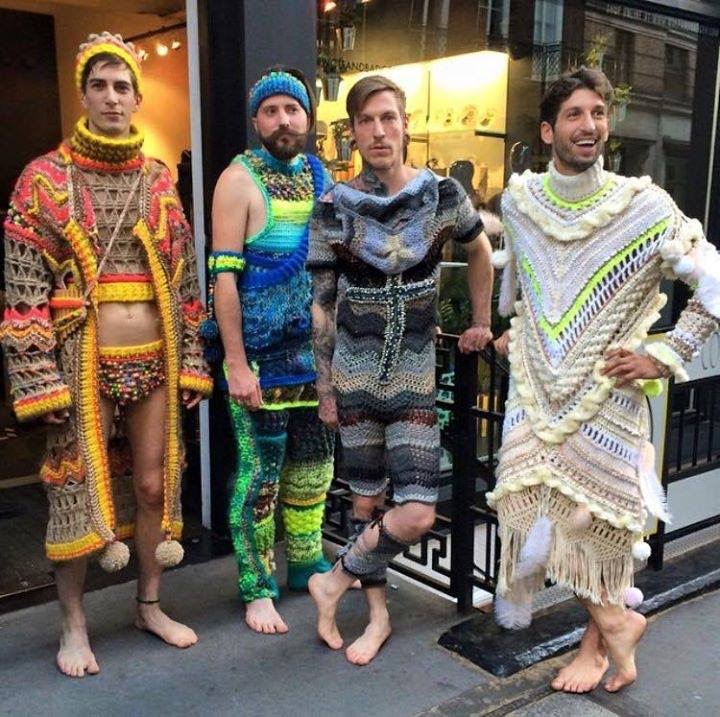
Tina is a stay-at-home mom, and around the time our younger two kids started preschool she decided to take up crochet.  What started as a way to pass the time while the kids were away has now turned into a nice little online business called Froggy Princess where she sells geeky crochet stuff and hair bows.  So obviously, whenever a friend finds a picture of something yarn-based and horrible, they send it to her as a joke.  A few weeks back, this one came across her Facebook feed, via Sam.


IMG_3135

Cringe-worthy, right?

So of course, Tina starts joking that Sam is making requests.  They banter back and forth, and then Tina implies that Sam would never actually wear one.

That was the first mistake.  Not only would Sam wear one, he would flounce down Michigan Avenue and post pictures online about it.  So he comes back with this gem:

“Knit one up for me and I will send you pictures.”

That was the second and third mistake.  As anyone who has crafty friends knows, you NEVER want to confuse knitting and crochet.  It’s the yarn equivalent to running your fingernails down a chalkboard.  Knitters knit, and crocheters crochet, and never the twain shall meet.  It’s like the Hatfields and the McCoys.  Sam knew this perfectly well, and said it just to get under Tina’s skin.  But worse was the implication that she wouldn’t do it.

So I get home from work that day and Tina is sitting there on the couch, two inches taller and eyes glowing, working her dusty old pair of knitting needles through some horrible purple variegated yarn.  I know something’s up.

“Hey love… what’s with the knitting?”

She doesn’t say a word, she just hands me her phone.  I read, and something inside me shrinks back in horror.

“Oh no,” I say.

“Oh yes,” she replies. “I WILL win this.”

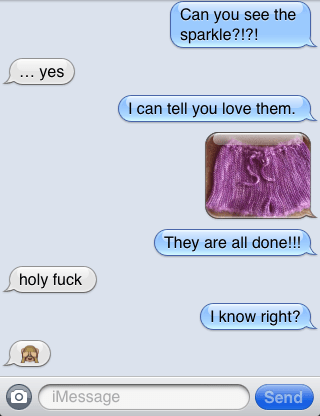
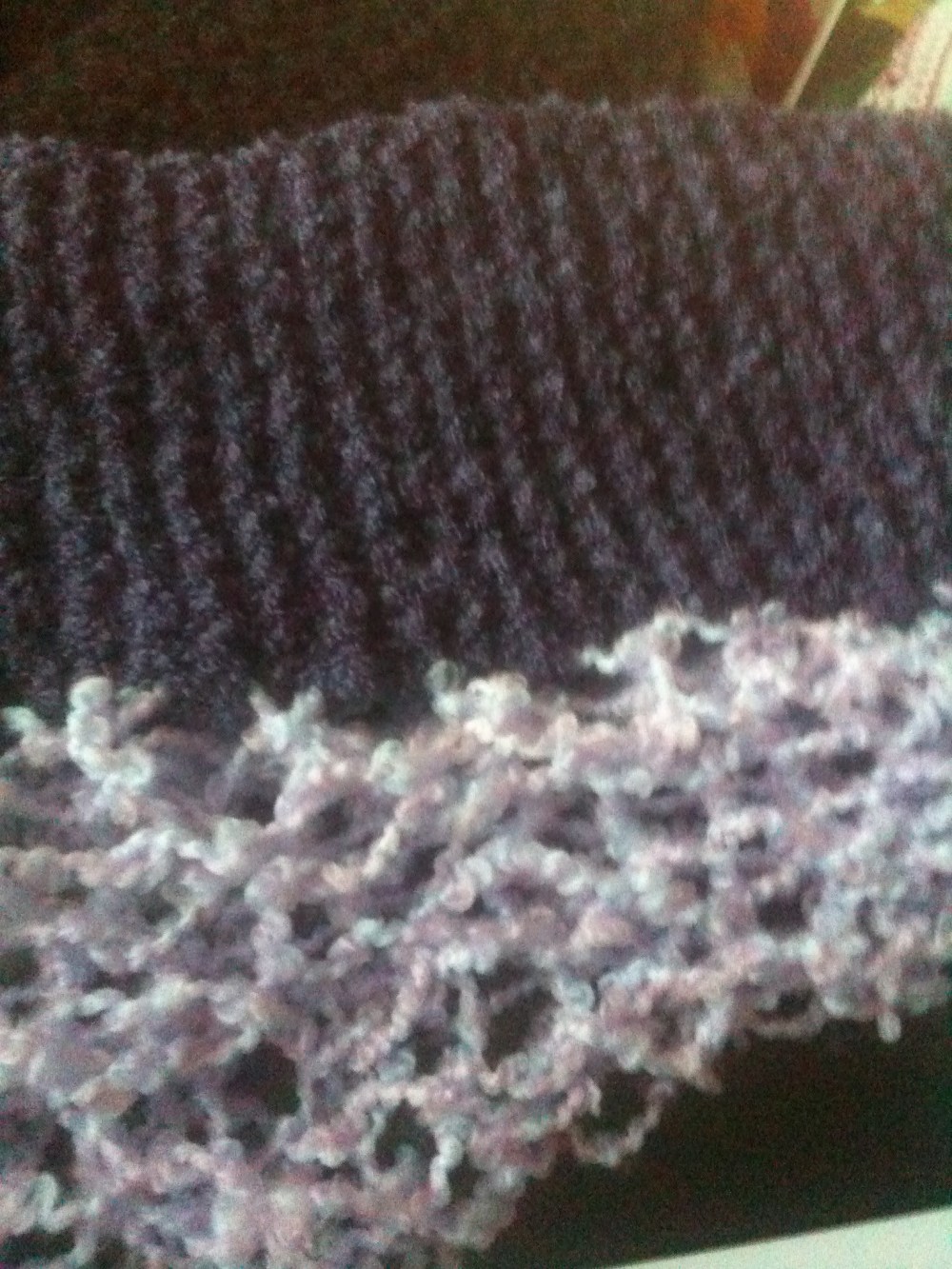
Thus has begun what I call the Battle of the Purple Shorts.  A war of texts has broken out between these two titans, each one waiting for the other to back down.  Every few days Tina drops Sam a pic of her latest few rows of purple horror

image

image

So I really don’t know how this is going to end.  Tina has no desire to see Sam in this monstrosity, yet she will not stop working on it.  Sam has no desire to wear, let alone own something this hideous, but he won’t ever cry uncle.  I just hope to God I’m not there when the final product changes hands. There are some things that can’t be unseen.

But that’s what happens when you dare a woman with needles.

The Spiritual Bias in Politics

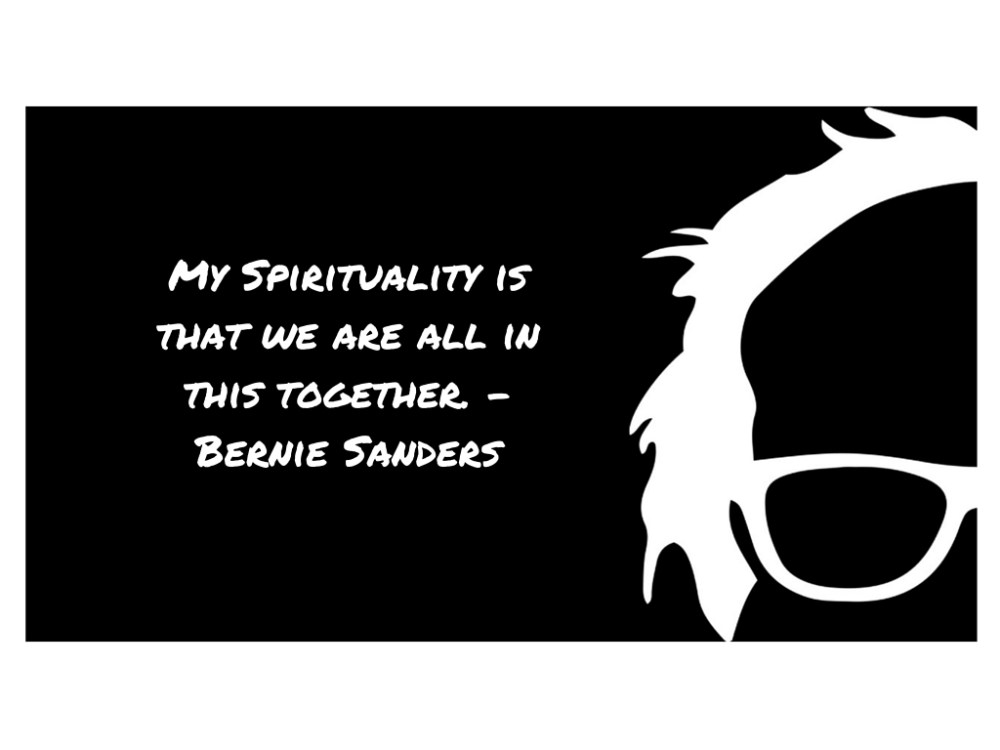
On February 23, 2016 at a CNN town hall meeting in South Carolina, Democratic presidential hopeful Senator Bernie Sanders was asked to elaborate on a statement he had said about his belief that “his spirituality is that we are all in this together”.  Sanders, a non-practicing Jew, then gave what I consider a brilliant response.

Four days later, Bernie would go on to lose the South Carolina primary by nearly a 3:1 margin, his worst showing yet by far.  The group that he did most poorly with was with African-Americans, who made up 61% of the voters that came out, despite the fact that he has a documented background as a civil rights activist. One interesting result from the exit polls showed that only 46% of the African-American voters consider themselves as liberals. More data from ABC here.

Now, there are any number of reasons that Sanders performed as poorly as he did in SC.  Part, I am sure, is his insistence on connecting racial issues and economic issues.  Another is his lackluster responses to the Black Lives Matter movement, especially earlier in his campaign.  But I think his answers in the video above highlight another contributing factor, especially among more conservative voters; the unspoken belief that no non-Christian candidate is electable.

That the Vermont senator is a strongly moral man is quite apparent, and his political record bears that out with stunning consistency. His message would make any true-blue follower of Christ smile: help the poor and needy, tax the wealthy, protect the planet.  But the views he espouses above, no matter how logical or kind, speak to a spiritual point of view that few traditionally-religious people would truly find comfortable.  Christianity as it exists today has a significant selfish streak in it that their Founder would not applaud.  Salvation today is now a personal, individual thing, and it is considered far better to be right than to be good.  This is not a universal malediction on my part, but it is common enough that the image that comes to people’s mind when they hear the phrase “devout Christian” is not one of kindness and mercy and generosity, but one of  close-mindedness, pride, and judgmentalism.

So when 54% of a certain voting demographic in South Carolina on Saturday does not consider themselves liberal, I see red flags.  An answer like in the video above will not play well to a religiously conservative crowd.  The moderator asked about a “Creator” in the senator’s philosophy, a question that was neatly sidestepped.  There is no clear right or wrong invoked, merely an idea of interconnectedness.  Are these ideas logical and correct?  Yes, but that doesn’t matter.  A great many voters choose their candidates based upon a sense of camaraderie, not logic.  Is this person like me?  Will they sympathize with my desires and needs?  And there is little that a Southern Baptist churchgoer would find in common with a socialist Jew from New England.

I am probably overstating the influence this town hall had on Bernie Sanders’ performance in the SC primary.  Hillary Clinton has a relationship with the African-American community that goes back decades, and as I said above, Bernie made many missteps.  But it does sadden me that, when at last I see a candidate speaking of a spirituality I resonate with, it seems that those very beliefs and ideas are undermining his electability.

My Spirituality is that we are all in this together. - Bernie Sanders

The First Warm Day

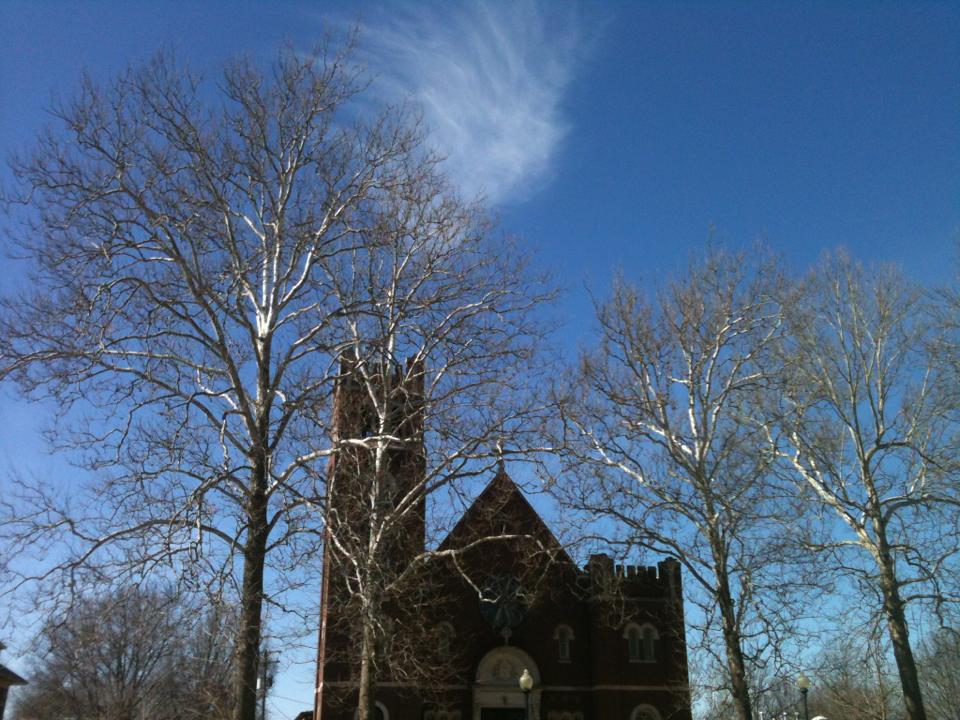
blueskychurch

February 20, 2016, 1pm.

58 degrees. 

I am walking to the park with my youngest two kids. The sun feels like spring already, and the sky is the soft blue of March or April, but the rest of the scenery is decidedly wintery still.  The trees are bare, the grass is still a matted brown, and the air, while unseasonably warm, smells of nothing but wet soil.

My town is at the bottom of a hole.  Two streams empty into the Illinois River here, making it prime territory for coal mines back at the turn of the century.  Between the streams and the now-abandoned mines, the entire town is a series of large steps working their way down towards the broad expanse of the Illinois.  What this means is that from our home by the riverfront and the library is as much a climb up as it is a walk across town.

My kids ride ahead and fall behind on their bikes, loving the flat areas but lagging as we tromp up the inclines.  I am not old yet, but I can’t call myself young or in particularly good shape, so by the time we make it to the library my legs buzz and I can feel my heart working in my chest.  The library is an odd looking building.  A century-old original structure at one end, a larger extension done in the ‘90s at the other, and city hall and the police department sitting next door, the entire effect is slightly Frankensteinian.  It is small by my standards; I grew up in the Chicago suburbs, where libraries were multi-story monsters with entire floors devoted to genres.  Here, each section consists of a handful of shelves, the staff no more than 4 older ladies.  But that’s what happens when you move from a city of 60,000 surrounded by others cities just as big to a town of 5500 surrounded by cornfields.

We wander the stacks for a while, pick out a few choice volumes, then make our way back out into the sunshine.  The kids bolt right for the park across the lot, racing for the best locations on the swings or monkey bars, bickering as usual.  They are only 19 months apart in age, and the competitions between them are kind of a default setting.  I turn my face up to the sun and let the south wind whip my hair back.  It’s getting long again, time to cut it unless I decide to ponytail it up again like I did for so many years.  For now it curls around my ears and hangs down to my collar.  The sunlight is still a bit watery, but I can feel it is stronger than it was just a few weeks ago.  I drink it in like an elixir, feeling it soak into me, filling me up.

I love these first hints of spring, these first reminders that winter is not eternal.  I know that in a day or two, the temperature will drop back into the 30s and the clouds will roll back in.  There will probably be at least one more measurable snow, at least one more snap that leaves frost on the car windshields and puts blades back into the wind.  But for now, just for a bit, I can pretend that winter is over.  I can pretend that the dark is finished and the sunlight has won again.

At least until November.

Politics, Religion, and Spirituality

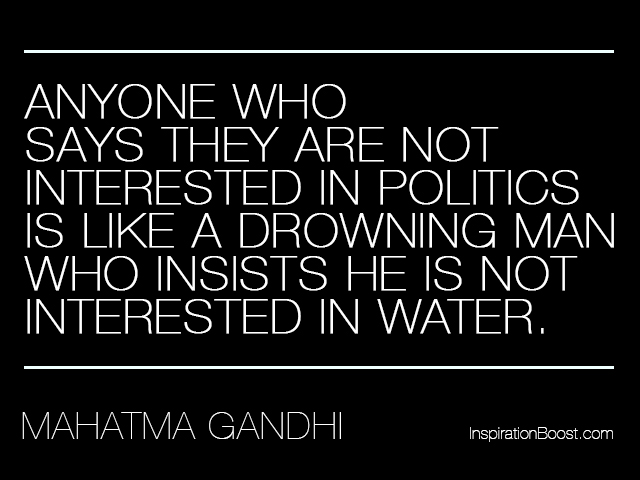
Mahatma-Gandhi-Political-Quotes

Let’s talk politics.

Yeah, yeah, I know, that’s a forbidden subject.  Keeping a blog is a little like going to Thanksgiving dinner; there are certain subjects you don’t want to broach because you know it will get messy.  But I’m not here to talk about my personal politics (though I will use them as a jumping-off point) so much as I want to talk about how politics and spirituality intertwine, whether we want them to or not.

So let’s start with the obvious.  I am a college-educated, non-affluent, Gen-X white male who writes alternative spirituality books, so my political leanings should be pretty predictable: liberal as they come.  Part of the reason I am such a complete and utter hippie is because of my distaste for the encroachment of traditional religious views into modern public and political discourse.  For someone whose spiritual views put the ideas of Werner Heisenberg, Lao Tsu, and Origen of Alexandria on the same footing, the idea of young-Earth creationism appearing in school textbooks is horrifying to say the least.  So of course I trot out the same arguments so many others of my ilk do: the First Amendment, the Deist leanings of many of the Founding Fathers, the mountains of evidence for evolution and an ancient Earth, so on and so forth.  We of a liberal mindset believe that we are bastions of reason against a sea of antiquated myths and fables, doing our best to hold our secular government sacrosanct from the influences of religion and its biases.

But are we really?

Look at the quote at the beginning of this post.  Mohandas Gandhi is remembered in the West as a political leader, one who used nonviolence as a brilliant weapon of propaganda to push Britain out of India.  Yet in his home country he is revered as much for his spiritual teachings as his political influence, earning the title Mahatma, meaning “great soul”.  For him, as you can see above, spirituality and politics were inextricably intertwined, and for good reason.  Both are structures by which we govern and decide what is acceptable or unacceptable in a society.  One uses social pressure and upbringing to enforce behavior, the other uses law and punishment, yet the both work toward the same end.

Americans sometimes forget that we and our time period are an anomaly.  For the majority of human history, political and religious power were interconnected and often indistinguishable.  For centuries kings ruled by divine right, popes held more influence than rulers, and a threat of excommunication was worse than death.  Our ideas of the separation of church and state are unique in history, and also almost impossible to enforce 100%.  How many laws have made it to the books in the United States whose basis is nothing more than assumptions based on Judeo-Christian teachings?  Every malediction against family planning, every heavy penalty for substance abuse, every attempt to criminalize non-traditional relationships is really nothing more than the Bible creeping into our lawbooks.

Yet this is not all bad.  Many of the finest dignities of humanity enshrined in our laws have their basis in religious doctrine.  Prior to Judaism, human sacrifice for religious purpose was the norm, property was only held through strength, and women were purely chattel to be stolen, bartered, and enslaved.  Religion changed all that, and I think we can all agree that it was for the better.  To deny religion’s hand in the creation of our current ideas of morality is disingenuous at best and blind at worst.

That really is the main division between American liberalism and conservatism; can law and morals be separated from traditional religion, and should it?  The former says yes, we can find the dignities in our traditions and keep them while discarding those which no longer reflect the society we desire.  The latter says no, we cannot separate our laws from their source without undercutting them completely.  Problems then arise, because the stalwarts of either side end up taking things to their extremes.  Liberal extremists deny religion any hand in our laws or morals despite their obvious source, conservative extremists insist that all religious tenets must be included in laws, no matter how archaic or inappropriate.  This is exacerbated in American politics by a myriad of other influences: gerrymandering, campaign financing, religious tax exemption, and others.

So where does that leave someone like me?  How do I ditch the bathwater while keeping the baby?  What part of morality can be separated from religion, if any?  For me personally, I feel the need to take things back to the source.  Is there a basis for morality, and therefore law, that runs even deeper than what traditional religions teach?  Is there a kernel, a perennial philosophy that underpins religion and therefore can be used as a basis for law without interference from cultural accumulations?  This is what I search for and what I try to express in my writings.

I think I’m onto something, but whether you agree with me is up to you.

#10LittleThings

February sucks.

frown

It does, admit it.  We’re well past the holidays, the weather is either -74 below zero or 34 drizzling and windy, the days are a bit longer than in January but not really that much yet, and then there’s Valentine’s Day which, let’s be honest, you only look forward to if you’re between 15 and 25 and in a relationship for less than a year.

February doubly sucks for me because I’m always creatively constipated during this Gray Bucket of Suck Month.  In the deep winter, as I’ve mentioned here before, my creativity hibernates due to mild SAD and job stress.  Come April or so my creative juices go nuts and I can’t get the ideas out of my head fast enough.  But during February I can feel the ideas waking up, but they’re not there yet and it’s bloody frustrating.  I need something to get me out of this funk, and I’m pretty sure I’m not the only one. So what to do?

We help each other out.

Each of us have things that make us happy no matter what.  I’m not talking about big meaningful stuff here, not the linchpins of your existence.  Just the stupid little things that get you through the day, the little reminders that this is a pretty neat world we live in, even if it does suck the pain pipe now and then.  And right now is one of those Nows for a lot of people, not just me.  So let’s share.  Let’s show the world the list of the little things that get us over the bumpy parts of our lives.

So here’s my list of #10LittleThings

  1. That first sip of coffee in the morning. Yeah, it’s a drug and I’m addicted, so what?A_small_cup_of_coffee
  2. That moment when you’re laughing with friends and it turns into a feedback loop where everyone else’s laughter just makes you laugh more even if it is because of the stupidest thing in the world and you end up with your stomach hurting and tears in your eyes and panting like you just ran a mile and then someone giggles and it sets all of you off again.                                                          laugh
  3. A patch of sunshine coming in a window on a cold day, one that looks so inviting that you just want to curl up in it like a cat.sunshine
  4. Soft blankets.soft-coral-fleece-blanket_3
  5. Perfectly clear blue skies, the ones so pristine they don’t look real.clear_blue_sky_by_nescio17-d656th1
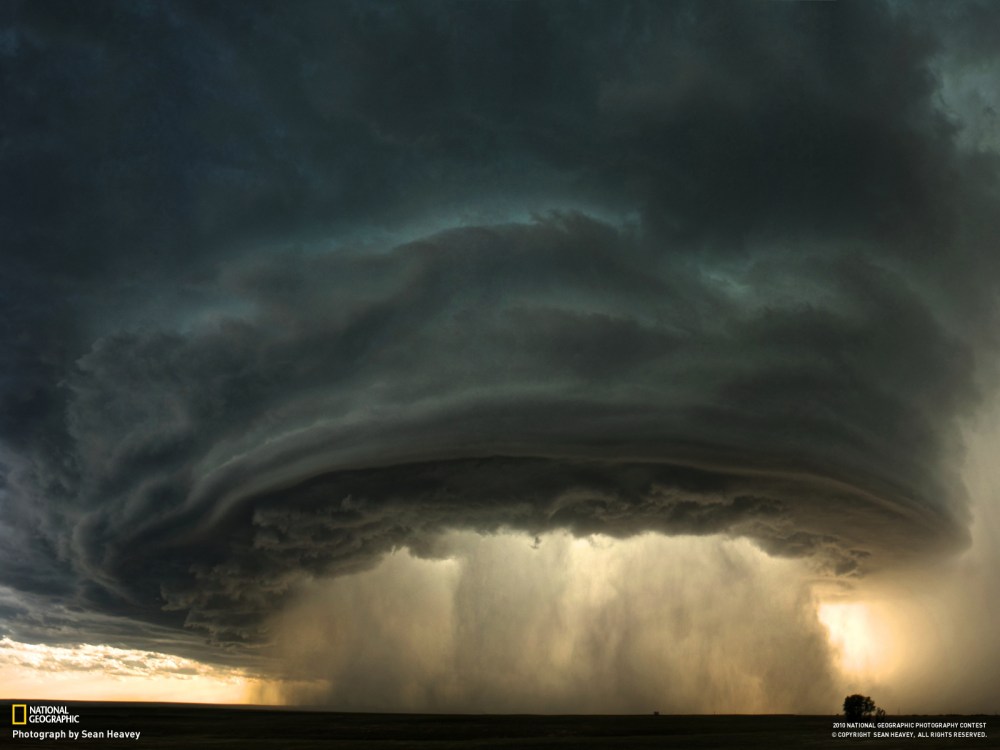
  6. Watching big thunderstorms roll up like the Wrath of God.storm
  7. Genuine hugs, not the stupid, one-arm-pat-your-back ones.love-hug1
  8. Those times when you really fall into a book, when everything around you ceases to exist and it’s like you’re living a movie.magic-book
  9. Chocolate.  Duh.dark-chocolate
  10. Deep conversations, the kind where you feed off each other and you get that rush like you could solve every problem in the world.conversations

My plan is to share this across FB and Twitter with the hashtag #10LittleThings.  Please share, comment, post, etc.  We all need a little boost during this time of year.  Let’s help each other out.

Why I Love Poetry

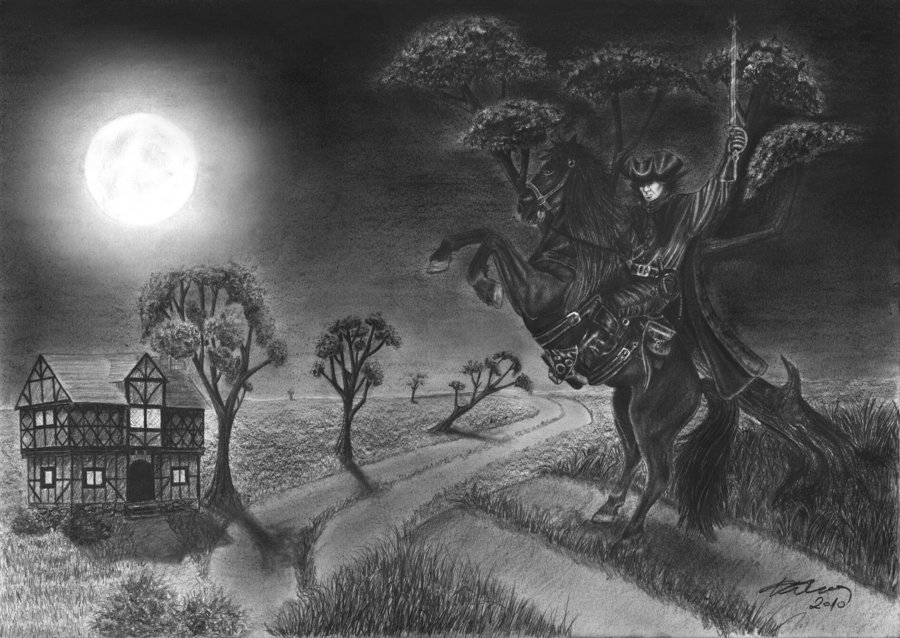
the_highwayman_by_tatjanaagness

The wind was a torrent of darkness among the gusty trees

The moon was a ghostly galleon tossed upon cloudy seas

The road was a ribbon of moonlight over the purple moor

And the Highwayman came riding, riding, riding

The Highwayman came riding up to the old inn door.

Poetry holds a special place in my heart.  Some of my earliest memories are of my mother reading to me from a ridiculously worn-out copy of Favorite Poems Old and New, some of which I can still recite by heart.  The above is one of them: The Highwayman by Alfred Noyes, but there were many others I loved.  Ogden Nash, T.S. Eliot, Edgar Allen Poe, and many others that most people have never heard of, these soothed me to sleep for years.

Later, when I first realized that I had words in my head that wanted out, poetry was my first outlet.  I suffered from serious insecurity and social anxiety issues when I was young, and poetry was the only creative form I had that could get past all of that.  The immediacy, the passion of a certain image or turn of phrase, these could carry through my doubts and get onto the page before my Inner Critic could stop them.  For years I kept them to myself, scribbling them down in notebooks I kept hidden in my room, but with the encouragement of some friends I began to share them, and then to perform them at a local coffee house’s open-mic poetry night.

There, I discovered I had a talent, far more of one than I gave myself credit for.  For years I thought my only worthwhile ability was in music, but now I had friends asking me to read certain pieces that they liked and strangers complimenting me, and I began to realize how ridiculous my worries had been.  Words and language had always come easily to me.  I couldn’t and still cannot tell you the difference between a participle and a gerund, but give me a mangled sentence or a convoluted turn of phrase and I can unravel it as easy as breathing.  To me, language is very much like music: ebb and flow, balance and tension, pressure and release.  It makes sense to me, and so it was only logical that I would be able to put words onto a page in a way people could enjoy.  The only real question is why it took me so long to realize it.

I do not write poetry nearly as often as I did 20 years ago, when I would sit at the No Exit Cafe every Tuesday night, drink their rocket-fuel coffee and scratch out 3 or 4 poems like clockwork.  My writing has gotten far longer now, more methodical, but every once in a while a turn of phrase or image will catch my ear and resonate, and I find myself diving for pen and paper to catch that fleeting snippet of inspiration that, at least to me, is at the heart of all good poems.

dirt-road-cornfield-brian-maloney

Rumble-pop dirt roads,

Scents of corn, dust, grass, sunshine,

Summertime road trip

This is why I will always love writing and reading poetry.  That crystalline moment they capture and convey, that precision of language, that conciseness.  Nothing else is like it, at least for me.

Holiday Recovery

Hello all, been a while.  Sorry about that.  What with the official launch of The Curious Snowflake, one would think I would be all over the social media and blogosphere, talking my literary prowess up.

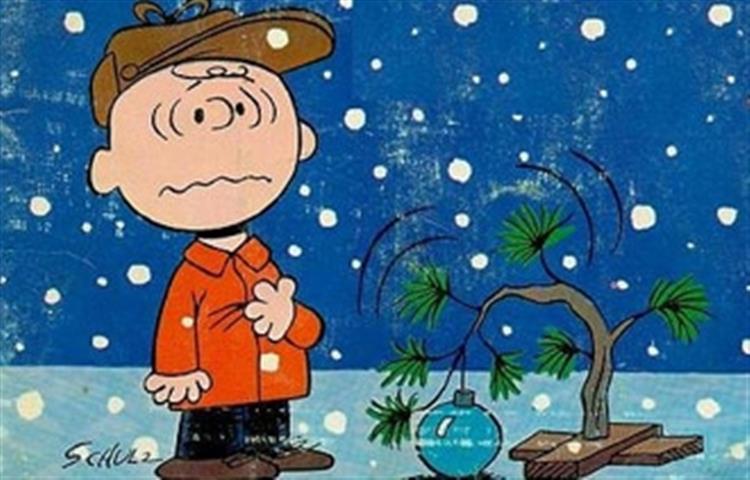
Holiday-Stress-Charlie-Brown-Small

Yeah, not so much.

Why?  A whole number of reasons.  Part is my job.  Writing, from a financial point of view, is a secondary thing for me.  My main income comes from working in retail management, specifically dealing with video games.  Needless to say, the holidays are a lot of work and a lot of stress for me: 6 day work weeks, massive holiday hiring and training, and all those people wanting PS4s and Xbox Ones for Little Johnny.  Part is just being a married father of 3 kids.  Every free moment is spent preparing for the 25th of December or running around to family gatherings, school programs, and other obligations.  Part of it is that my creativity is keyed to the seasonal changes.  Spring and Summer are my big creative times.  The ideas and motivation come fast and furious, and I usually find myself frantically scribbling thoughts on any spare scrap of paper I can find, just to get them out of my head before it pops like an overinflated balloon.  Come around November or so, though, the ideas… not so much stop as tone down.  They are there, but they are quieter, more polite.  During the long daylight months, my creativity is like what Richard Bach described in the introduction to his book Illusions, an 800 lb gorilla that smashes through walls and grabs me by the scruff of the neck.  In Fall and Winter, my creativity resembles a shy accountant at a dinner party, standing in a corner fingering a drink or softly interjecting itself into conversations with a polite clearing of the throat.

Between these, I find coming to the page (or in this case the keyboard) to be a challenge.  I’m sure I’m not the only one.  More than a few of you feel the stresses of the holidays and the darker days of the year, I’m quite sure. The worst part for me, really, is that I lose momentum.  Like any creative, I suffer from doubts, and now that I am published I find the doubts are, if anything, worse than before.  When TCS was just pixels on my monitor the doubts were all internal, but now that it’s out there in the world every day that passes with a drop in sales and rankings feels like a judgment.  The insecure introvert in my wants to just walk away, give up before things really even start.  If this is the reception I can expect, I think, why bother at all?  Of course, that’s not an option and never has been.  I can’t stop creating any more than I can stop breathing.  But the drag of all of this makes coming to the page every day a slog, the emotional equivalent of trying to push a cart out of deep mud: slow, messy, and frustrating.

There’s a term we in retail use for the work that needs to be done after we get through the first week of January: Holiday Recovery.  It’s the list of tasks we need to do to fix up the store after the insanity of December, the catching-up on tasks we let slip, the shift in gears back into the more normal way of working.  As a creative, and especially a published one, I need to do a personal Holiday Recovery.  Come back to the page every day, even if it is just to write a couple of sentences.  Take time to refill my soul, give myself the little indulgences, the moments of peace, the few seconds to enjoy a scene of beauty.  Place myself in the digital world, so that anyone who has been touched by my ideas or may wish to be can interact with me, see me as something approachable and worthy of such.  Do the thing, and then do the thing again.

I’m sure some of you have similar experiences.  Tell me your stories.  How do you recover from the holidays, or from any stressful time?  I’d love to hear from you.

Happy January.

It’s Really Real.

books

A 14 hour shift, from 3:30 AM to 5:30 PM, on two hours of sleep.  Not an ideal situation by any means, and made far worse by the reason for it: Black Friday.  To say I was exhausted when I got home would the greatest of understatements.  Closer would be that I felt like I’d been beaten with sticks and dragged backwards by one ankle through a running bumper car carnival ride.  Couple that with the strange, overwound feeling you get when you drink 6 cups of coffee and not eat enough and you’ll have a pretty good idea of how I felt on Friday when I got home.

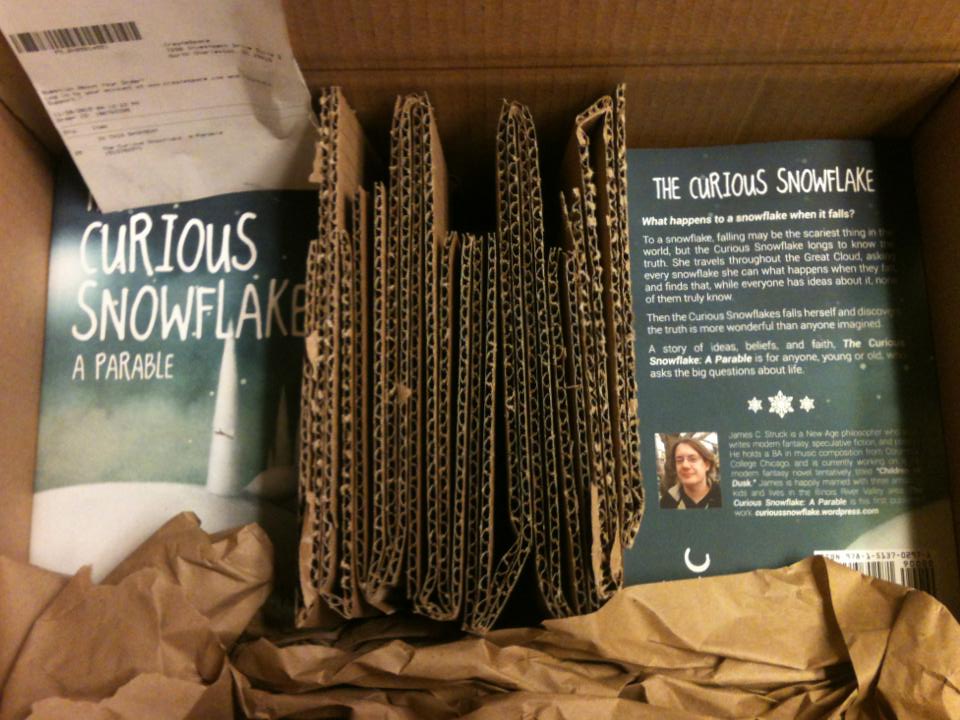
And then I got this box.

I got the original idea for The Curious Snowflake sometime around the autumn of 2005, give or take.  I finally put it down on paper in April of 2009, published it on Kindle in September of 2010, and finally got behind self-promotion of it in late summer of 2013.  I first heard of my publisher Booktrope last autumn from my dear friend and fellow author Dennis Sharpe, sent my query email to them in February, got accepted in April, and spent the entire summer in team building, edits, and adjustments. Ten-and-a-half years this idea has been with me.  In that time my two youngest children were born, we moved 100 miles from where my wife and I grew up, I went from a part-time librarian to a full-time retail manager, I cut off my ponytail, gained 15 pounds, lost 30, then gained 15 back again, bought a house, went gray and got bifocals.  Yet this idea has remained, and my belief in it has never wavered.  My philosophy has evolved, deepened, matured, and the edits show that, but the core of TCS is unchanged: curiosity is beautiful, no one really understands life completely, the insistence on being Right is the most damaging idea humans have ever devised, there is no judgment in the Divine, All is One merely appearing separate.  The durability of TCS’s basic ideas is my greatest philosophical joy, and my greatest source of gratitude.

And here it is, at long last. I can hold it in my hands.

I opened the box in the kitchen, surrounded by over-bright florescents and that horrible 70’s yellow wallpaper we haven’t gotten rid of just yet, and just smiled.  Then I called my wife in and handed her the first copy out of the box.  She grinned and threw her arms around my neck, whispering in my ear how proud she was of me.  I handed a copy to each of my kids, then took the other 21 into the bedroom, carefully unpacked them, and spread them out on the bed.  Then I just sat there and stared at them, too exhausted to do the silly happy dance I otherwise would do, trying to wrap my head around the truth: I am a published author.

I don’t know what will happen now.  TCS could continue to flounder in obscurity, despite everything Booktrope and my book manager and I will do.  It could sell a few hundred copies, touch a few people, and then be forgotten.  It could take off, allow me to be a full-time author, share my ideas for a living.  I have no idea.  None of that really matters right now, though.  What matters is those words, on a page in a real book, those words I wrote over a decade or so, on a yellow legal pad, while sitting on my bed.

“Once upon a time there was a Snowflake.”

🙂

The Undiscovered Country

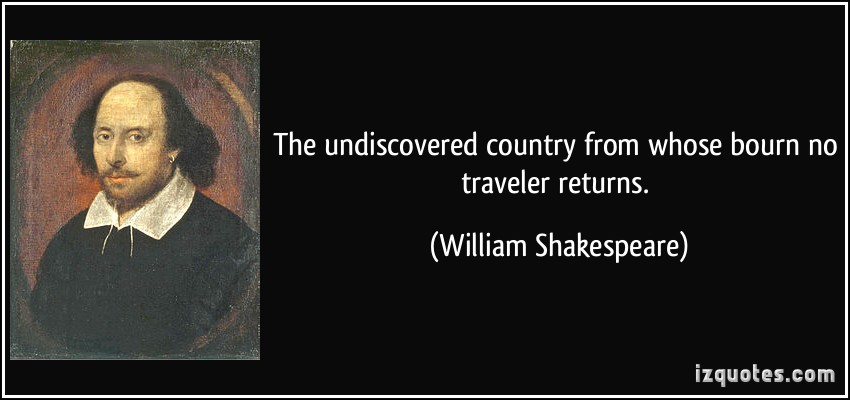
But that the dread of something after death,
The undiscovered country from whose bourn
No traveler returns, puzzles the will
And makes us rather bear those ills we have
Than fly to others that we know not of?

One of the more famous lines from probably the most famous soliloquy in the English language.  While the Melancholy Dane was contemplating suicide out of despair, the lines Shakespeare wrote speak to a much broader truth; we, as a society, are scared to death of Death.

So why is that true?  Why do we who live in the most Christian of nations fear the dispositions of our souls so deeply?  Well, to be honest, I think that is precisely the problem.  For better or for worse, Christianity is a religion based upon uncertainty.  Theirs is a very particular God, one who wishes to be believed in and worshiped in very specific ways.  What those ways are is open to a massive amount of debate, as evidenced by the fact that there are at least 35 denominations with over 25K members in the US alone.  If these Godly demands and preferences are met, all is right with the world, but if not the consequences are severe to the extreme.  With this Sword of Damocles hanging over the souls of such a large portion of the population, is it any wonder that our society is so scared about mortality?

graveyard

This goes much further than simple fear of death, however, and into the realm of borderline neurosis.  Western society is so frightened of death that even any reminders of it must be shunted away.  We mask our true ages with powders, creams, colorants and surgeries, we pack off our aged relatives to “retirement communities” instead of venerating them as founts of knowledge and experience, we spend phenomenal sums of money keeping people alive long past any chance of comfort or even consciousness, we have legal battles over whether a bundle of cells the size of a pinhead should be protected under the full auspice of the law and demonize those who disagree as murderers, all because of an unspoken assumption; that life is always, always preferable to death.

But what if that is incorrect?
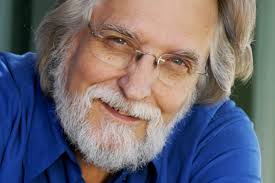
NDW

God, in a sense, does not even care about the outcome. Not the ultimate outcome. This is because the ultimate outcome is assured. And this is the second great illusion of man: that the outcome of life is in doubt.

It is this doubt about ultimate outcome that has created your greatest enemy, which is fear. For if you doubt outcome, then you must doubt Creator —you must doubt God. And if you doubt God, you must live in fear and guilt all your life.

-Neale Donald Walsch, Conversations With God, Book 1

Mr. Walsch’s ultimate outcome is a bit broader than my point here, but the idea is the same.  Because we doubt the ultimate end point of our souls, we live in endless fear.  So we run from death, hide from death, pretend that death is something as far away as possible, and in doing so, we fail to actually live.  Yet how can I be sure that this is wrong?  Perhaps this is really how God set this whole life thing up.

Well, personally I find that highly doubtful, mostly because that puts some ridiculous limits on the Divine.

Let me explain.  Imagine being God.  I know, big stretch, but bear with me.  You are God, and you desire something.  Does it come to pass?  Of course!  You are God, the Alpha and Omega, so that which you desire, is.  Simple as that.  There is no way that an Almighty Being could desire something and have it be unattainable.  More than that, this implies something about existence that has massive consequences: the world is exactly as God desires it to be.

This is an idea that humanity has been grappling with for millennia.  We look at the world and see that it has flaws: war, famine, inequality, disease, cruelty, senselessness.  Yet if we are to believe in any sort of deity, we must reconcile the imperfections of the world with the idea that our Divine Creator must have a hand in those flaws being there.  In earlier times, humanity explained this away by creating deities as flawed as any human, full of vices and foibles, conflicts and lusts.  Later, as polytheism fell by the wayside and monotheistic ideas came to hold sway, we concentrated all of the negative godly aspects into an Adversary, whose corrupting influence was responsible for the world’s woes.  When this wasn’t enough, we imagined that it was we, not God, who was responsible for the world’s imperfections.  We, the thought goes, are the sinful ones, the fallen ones, the imperfect ones.  The world is fine, it’s us dirty humans that muck it up, and there is a certain elegance to that point of view.  Yet this still doesn’t satisfy the logical mind, for how could a perfect Divine create something imperfect?  How could our Heavenly Father want us to be with Him, yet have that not come to pass?  It is this line of thinking that has led many people to become atheists, turning away from all ideas of the Divine and putting all their faith into empiricism, laying all blame for the world directly at our feet.

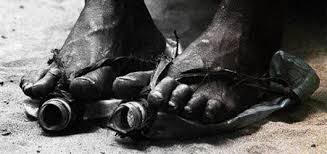
bottlefeet

So where does this leave us?  It may sound like I’m making a case for atheism, but I am not, mostly because the very proof that atheist point at is the same that I use to reinforce my faith in the Divine.  The problem, I feel, is that too many faiths have not gone far enough in removing the human aspects from God.  There are still too many leftovers from that polytheistic era, too many assumptions that our desires and preferences are the same ones that a deity would have.  We assume that, since we want the world to be a certain way, God must want that too.  But then we must ask the question; what does God want?  Obviously, if we have an infinite Deity and universe that we are pretty sure had a beginning, then there must be a reason for Creation.  What is it?

This is the real starting point, so please bear with me, this will get a little esoteric.

What could a infinite and all-powerful being desire?  Desire implies a lack, that there is something that is wanted that is not manifest, so is there something an omnipotent God could not have?  Oddly enough, the answer is yes, and that one thing is experience.  In order to experience something, you have to be limited.  You have to have a time that you do not have this experience so that you can go through the process of having it.  Also, this implies a linear progression through Time, something else that a true unlimited God would not and could not have, because a linear existence would be a limitation.  Finally, in order for there to be experience, there has to be separation into that-which-has-experience and that-which-is-experienced.  For example, in order to be loving, there must be an object of that love.  In order to be compassionate, there must be another for whom we can feel compassion.  All experience require this separateness.

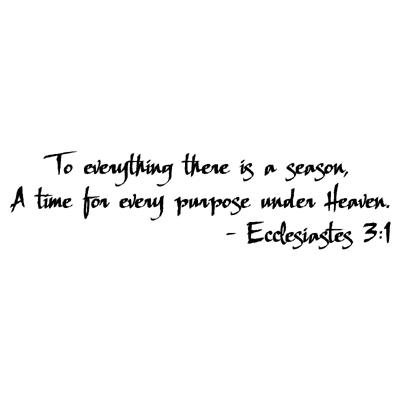
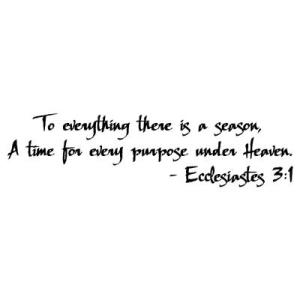
This then not only lays out the groundwork for a reason for God creating the Universe, but also creates a framework to explain why negative things exist.  Let’s go back to the idea of compassion.  Compassion is obviously a very positive emotion, yet for it to exist at all there must be some sort of negativity.  Someone has to have gone through a tragedy, a hardship, a damaging experience of some kind in order for us to feel compassionate towards them.  Yet this goes even deeper.  Love obviously has no similar requirements, yet if we are to experience love we must have some concept of not-love to contrast it against.  In order to truly understand love, the ideas of loneliness, heartache, loss, fear, and anger must exist as well, otherwise love has no meaning whatsoever.  Therefore we must have total freedom to create whatever sorts of experiences we choose, because even the negative things we do to each other serve as a point of contrast for the positive.  All things, as they say, work together for good.  To everything there is a season, and a time and a purpose under Heaven.
ToEverythingThereIsASeason1_400

So what does all this have to do with fear of death?  Well, there are two reasons we are afraid to die: 1) we think God will punish us for not being what He wants us to be, or 2) that we wink out of existence forever.  So let’s look at the first.  This is obviously based on human preference, that we value the things we call positive over those we label as negative.  Yet if the Divine has set it up so that we can experience all of it, the good and the bad, why could there ever be any sort of punitive afterlife?  Why would God punish us for doing precisely what he wants us to do, which is precisely whatever WE want to do?  This only makes sense if we have a very limited Deity, one who suffers from very human limitations.  Only a limited God could have preferences as to what we do nor do not do, yet only a truly Unlimited Divine makes any kind of sense.

This then brings me to the second point.  Do we snuff out like candles when we die?  Well, let’s look first at some scientific facts.  First, we know scientifically that nothing in existence can be created or destroyed, only changed.  Matter can turn into energy, energy condensed into matter, kinetic energy into potential, atoms split or fused, and so on.  Second, we know from quantum mechanics that everything is interconnected and that at the subatomic level nothing truly exists in a specific location or state.  Now, let’s combine those facts with my God-concept, an idea of a completely unlimited Divine.  What is the result?  If God is unlimited, then existence cannot be something separate from God because that would create a limitation, something God could not be.  This correlates with the idea that the stuff of existence is indestructible and interconnected.  So what does that mean?

We are God, experiencing Ourselves.

infinity

That, in my opinion, is the purpose of all of existence, to create a stage upon which the Divine can experience Itself.  At the deepest and most fundamental level, all is a unified Oneness, dividing and reforming into infinite shapes and combinations throughout the Kosmos, all for the purpose of creating the one thing this Oneness could not do on its own: experience.  And if this is true, what does that say about us?  We do not and cannot wink out of existence when we die, because to do so is scientifically impossible and spiritually ridiculous.  We are this Oneness in fractal microcosmic form, as immutable and eternal as Universe itself.

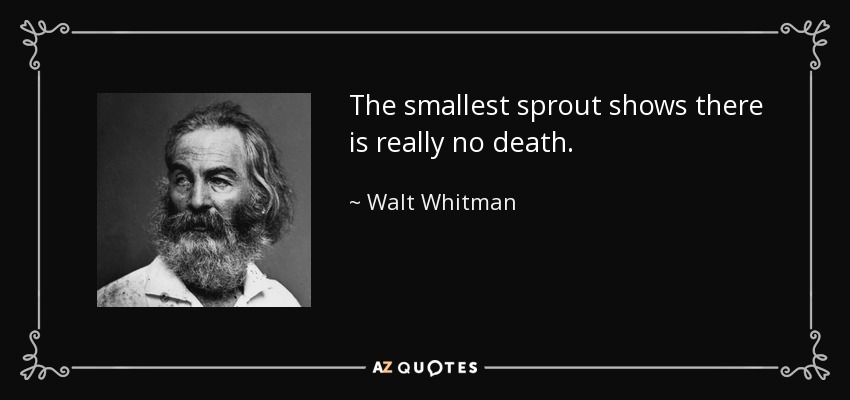
So, in closing, do not fear the Undiscovered Country.  Our neurotic panic over our own mortality is nothing more than an illusion, brought about by limited perspective and a few thousand years of misinformed opinions about God.  Our deaths will be nothing more than a transition to a different state, one where the perspectives of time and separateness drop away and we can see the whole of our existence laid plain, like a great patchwork weave of experiences and choices.  Death, as Walt Whitman wrote, is far different than we have supposed, and luckier.
quote-the-smallest-sprout-shows-there-is-really-no-death-walt-whitman-79-83-41