A Critique of the Modern Dystopia Fad

dystopia

love a good dystopia.

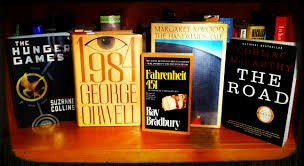
I don’t know why, really. I am a very optimistic person (a little too optimistic if you ask my wife) and I truly believe that, while we as a species have made some rather dopey choices over the last 150 years or so, we can still right the ship and create a better world than the one we currently occupy. But this doesn’t change the fact that my book collection holds a plethora of well-worn dystopian novels. I have read the classics numerous times: 1984, Brave New World, Fahrenheit 451, The Handmaid’s Tale, and so on, and I find them fascinating. I think it is connected with my love of understanding people and what makes them tick; what is the difference, really, between a foul-tempered, controlling person and the nation of Oceania?  The latter is simply the former writ large.

In case you’ve been living under a literary rock (and if you’re reading this blog I highly doubt that) dystopias are a hot commodity right now, and I’ve loved them.  Hunger Games?  Excellent, though I actually like Ms. Collins’ Gregor the Overlander series a little better.  Insurgent?  Also good, though I’ve only read the first book.  Ready Player One?  Just knocked it out in about 36 hours, talked it up to everyone.

But they’re not really dystopian.

Now, they are dystopian settings, to be sure.  President Snow’s cruelty would make Big Brother nod in approval, and Huxley’s Soma has nothing on the OASIS, but in these modern dystopias, the characters are placed front and center, not the world.  They have moments of triumph, moments of peace, moments of love, and these drive the narrative.  More importantly, there is a ray of hope in the modern dystopias. It may be a dim ray, but it is there. In the great dystopian classics, the hope only exists to us, not to the characters. We know that Offred’s world changes, we know that books still exist in Montag’s mind even after being burnt, but these salvations are not meant for the characters we’ve come to know.

This dissonance between the hopelessness of the world and the hopefulness of the characters grates on me slightly. In my heart, I don’t want the characters to win.  I don’t want happily ever after, or any after, really.  What I want from a dystopian novel is a note of caution.  I want them to be a warning to us, that these imaginings are far more proximate to our reality than we want to realize.  Just a nudge, a bump of the hip, and we could be there, slogging in the coal mines of District 12 and praying not to become tributes, or jacked into our haptic rig for 18 hours a day, every hair shaved for maximum contact.  Dystopian novels are supposed to be cautionary tales, and these modern stories, for all their undeniable quality, lack that.

A Sense of Accomplishment

I start way more things than I finish.

I think that’s pretty common for writers.  We get the idea, the great and glowing thing in our heads, and we dash off to our computer (or in my case, my notebook) and get to work, scribbling or tapping away.  Sometimes the idea just dries up and we stop.  Sometimes we keep going for a while and then we get another idea and drop the first one.  Sometimes we keep at it but our doubts and insecurities and lives and busyness and procrastination and what have you just get in the way.

But sometimes, just sometimes, none of this happens.

I’ve just today finished the longest thing I’ve ever written.  It took me 13 months (yeah, no NaNoWriMo for Jimmy) to write 157 pages of longhand YA modern fantasy novel.  It’s the first time I’ve ever finished anything close to this length that was fiction; most of my longer stuff is philosophical ramblings.  The previous story record was about 50 pages and that was in 2003.  And the best part is that I’m not done.  The story, assuming I finish it, is a trilogy.

So why am I bothering to document this in Cyberspace, and why do I think anyone else will give a crap about it?

We live in a society where accomplishment is measured in material things.  Success is weighed in square footage of house, names on clothing tags, shininess of car.  We rarely allow ourselves, or perhaps we are rarely allowed, to feel accomplishment for its own sake, to just feel good about “hey, I did that”.  It has to be “okay, you did that, now what will you do with it?”  Everything has to be a product.

Yet real accomplishment has nothing to do with that.  Our sense of worth and worthiness is garnered from being something, not having something.  Think of the times you really felt good about yourself.  Did it have anything to do with some material acquisition, or did it come from within?  Neale Donald Walsch once wrote that part of the reason our society is so unhappy is because we have what he calls the “be/do/have paradigm” upside down.  We think that, in order to be something, happy for instance, we have to have something first, like more money.  This having will allow us to do things (take a trip, buy a house, pay a bill) which will then allow us to be what we want (happy).  He says that we have this backwards.  We instead should decide what we want to be, then do things that move us towards that.  This will then create things to have that work with the doing and being.

Today I have finished my book.  I did this because I chose to be a writer and to stick to it, no matter what.  This led me to do something, which was to make time to write every day, even if it was just a few minutes to write a few words.  This made it possible for me to have a finished book, and a great sense of accomplishment because of it.

Mr. Walsch might be onto something. 🙂

What It’s Like To Be A Writer

20150707-202009.jpg

Being a writer is unlike any other creative profession, and I know this because I’ve tried quite a few. I’ve been a performing musician since I was a kid, and trust me, writing is completely different than music or theatre or just about anything else I’ve ever tried. Why? Because writers are completely nuts. Let me give you a few examples.

We have people living in our heads, and they can be little assholes.

Writing can be a very inconvenient creative outlet, mostly because the characters that we dream up (or perhaps find, but that’s a different blog post) really are little people in our heads. And just like real people, fictional people can be demanding. They want attention, have cranky days, act impulsively and thoughtlessly, and sometimes want to be heard at times that are inconvenient to say the least. Like while you’re driving 70 mph down the interstate. Or at 2:30 AM.

Worse yet, they have times when they don’t want to talk to us. Maybe they’re sulking, maybe they’re tired, maybe they’re just feeling stubborn, but no matter the reason sometimes our fictional friends just clam up. Of course, we writers aren’t really allowed to deal with this the way we really should. If a friend or a loved one decides they don’t want to talk to you, it’s perfectly acceptable to get upset or hurt, but if a fictional character does? Suck it up. Doesn’t matter how much you miss them, doesn’t matter how much it hurts, because as far as the rest of the world is concerned, fictional people aren’t real.

We writers know better. Yes, I know how crazy that sounds.

We have strange obsessions with things having to do with writing and the written word.

I am an old school writer, pen and paper. Mostly this is because it keeps me from editing the idea to death, but the downside of this I am obsessed with notebooks and pens. In any room of my house there are at least 3-4 notebooks hidden somewhere: shoved onto bookshelves, mixed in with my sheet music, on the end table, under the couch, on the dresser. And yes, this does not endear me to my loving wife.

Of course, she also bought me a leather bound journal for Father’s Day. Thank you, my Love. 🙂

Then there’s my pens. Unlike notebooks, where I am a gourmand, with pens I am a gourmet. I buy and use one kind of pen and one kind only: Pentel RSVP Black Fine Tip. I believe I have at least 42 of them scattered around my house and my work, as well as at least one package of multicolored RSVPs for edits.

And yet every time I go to Target or Walmart or (oh god help me) Staples, I am drawn to the stationary aisle as though there’s a black hole there that only affects me. They’re a drug, I’m addicted.

And don’t get me started on our book collections

One day, the foundation of my house is going to throw up its figurative arms, say “gg”, and collapse under the sheer weight of the books inside it. This is SO much worse than the notebook thing, partly because I’ve been reading since I was 4 but writing only since I was 15, but mostly because my whole family are addicts of the written word. There isn’t a horizontal surface in my house that does not house at least one book. The closing of a local book store was a cause for tears, no joke. No book aisle can be simply walked past by my family.

Every author I know is like this. Our bookshelves are packed two rows deep and then more books are stacked in front of them, usually divided into “read”, “unread”, and “get to it one day”. And god help us if we discover a new author we love, especially a prolific one. Or a series that is out of print, that’s even worse.

Discount bins? $1 racks at local resale shops? Library book sales? They’re like rolling a wheelbarrow of crack out in front of a junkie. I could not tell you how many books I’ve purchased because “it’s only $1, it’s only $.50”. Shit I will never read. I bought a copy on the Quran in Arabic and a Latin Vulgate Bible. Why? They were pretty and I wanted to see if they would spontaneously combust if I put them next to each other on the shelf. It’s pathetic.

Mood = Creative Output

There is nothing, nothing more sad and pathetic than a stuck writer. I know, I’ve been there. It’s like being emotionally constipated. We are surly, moody, sulky, and generally unpleasant to be around.

If anything, being on a roll is worse.

Not for the writer, mind you. For us, being on a roll is like being in love: Cloud Nine. But just like being in love, the only person who can stand being around us is the object of our affection. To everyone else, we are vague, selfish, absorbed, and obsessed. I knocked out my first draft of The Curious Snowflake in less than two weeks, and my wife told me later I was impossible to live with, utterly somewhere else. The only time writers are worth being around are on good editing days, and even that’s a stretch.

Everybody else is character fodder.

My MMC in my WIP (male main character in my work-in-progress, get with the nomenclature) is part me, part my son, and is based physically on one of my employees. His mentor is a short version of an old college buddy. The villain is my old voice coach (actually a great guy).

This is how it works. Authors want to make characters who are actually people, so they end up being a pastiche of the people we actually know. Famous, best selling authors do this all the time. Don’t believe me? Read the section at the beginning of Stephen King’s On Writing where he talks about meeting his wife and then go back and read, say, ‘Salem’s Lot or The Stand. Yeah, there’s a little Tabby King in almost every FMC ol’ Steve’s ever written.

So don’t piss off your writer friends, or you might find yourself immortalized in their prose.

So yeah, we’re basically nucking futz

Obsessive. Selfish. Oblivious. Moody. Judgmental. Perhaps even a little schizo-affective. So why does the rest of the world put up with us writers? Because we are also are loving, inspiring, thoughtful, and (at the best times) a little bit amazing. Most important, we write these stories and ideas that touch other people in positive and even wonderful ways. For that, I think, the rest of the “normal” people should cut us nutty authors a little slack.
Read To Your Kids

“It’s my turn to go first!”
“No, you went first yesterday!”
“But Daddy was at work so we didn’t read mine.”
“I want to sit in the middle!”

This is our chaotic and wonderful nightly ritual: story time. My kids are 16, 9 1/2 and 8, and this has been a part of out evenings for years. We eat dinner, shower when applicable, jammie up, and squeeze together onto our couch to read; my wife, me, and the younger two E and G shoehorned together, and our galumphing teenager D on the love seat because he just doesn’t fit anymore.

Over time the ritual has changed. Originally it was a chapter for the oldest and a picture book apiece for the others, and for a bit D dropped out due to lack of interest in Dick and Jane and Dr Seuss, but about 3 years ago it turned into a whole family tradition.

My wife and I are both voracious readers and were both precocious kids, so it was no surprise that all three of our children read early and easily. By the time E and G were school age they were losing interest in the “age appropriate” literature and wanted something they could sink their teeth into. So, trusting in my kid’s maturity and wanting to challenge them a bit, I dug into our own collection and pulled out Harry Potter.

Good call, Jimbo, good call.

Needless to say, they loved it. Even D, who had decided that gaming online with school friends was more fun than story time, gravitated over to listen. Over the course of 8 months we plowed through all 7 HP novels, then moved onto others: The Hobbit, Series of Unfortunate Events, the ‘Nother Story trilogy, Where The Mountain Meets the Moon, and most recently Narnia and Percy Jackson. Always, I am amazed at how much the younger two retain, even when they get antsy and don’t seem to pay attention, and always I am amused at how much D enjoys himself, even when he feigns disinterest.

Now I’m not claiming that nightly stories are the secret to the perfect family. Our kids are not perfect and neither are we. There are fights and boredom and sass and moments of lost temper from all 5 of us. But I’m pretty sure we are raising a family with an appreciation for the written word. I’m pretty sure that we are creating good bonds with our kids. And most importantly, my wife and I are pretty sure that, despite the imperfections, we are creating good memories. When D and E and G are grown, my hope is that they will look back at their childhoods, remember this, and smile. That, I think, is the best thing a parent can give their children.

So read to your kids.